

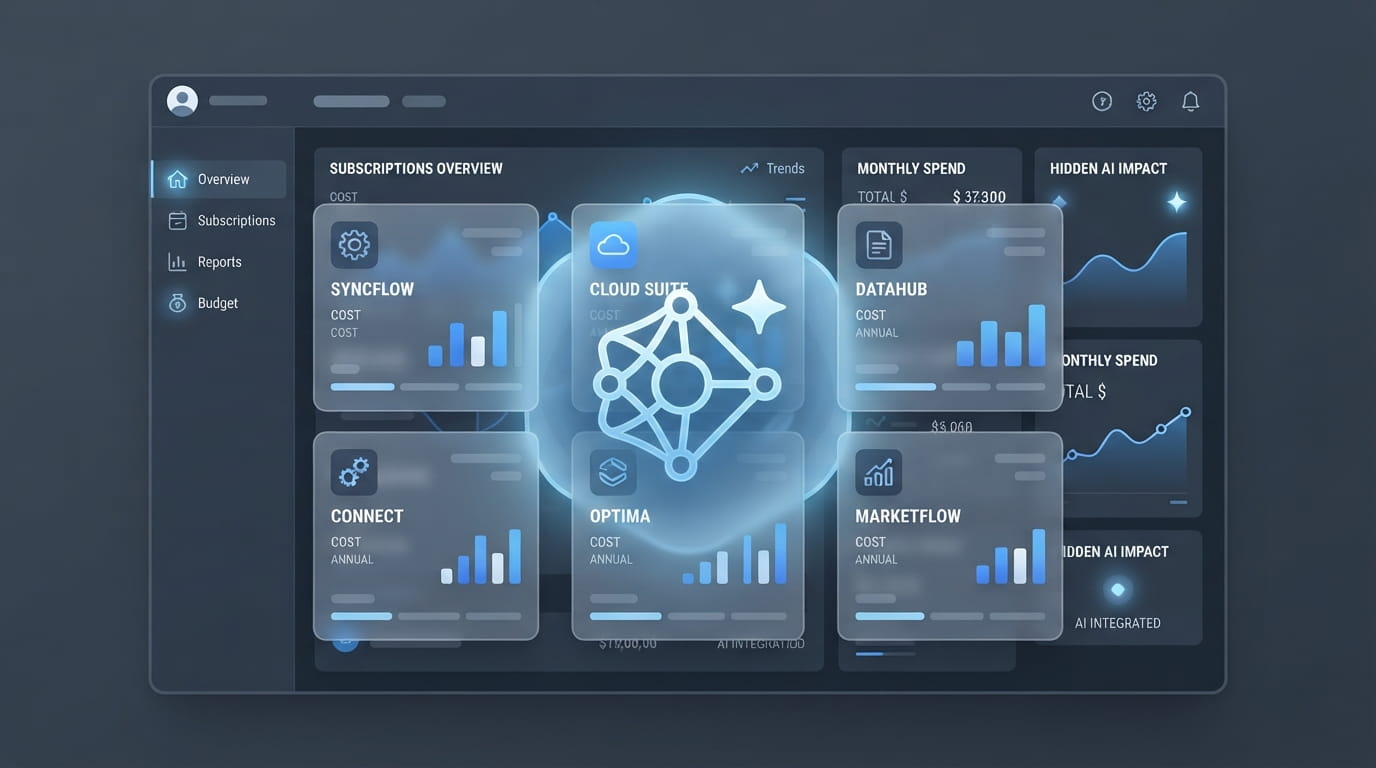
Shadow AI spend is no longer a rounding error on the software budget — it is one of the fastest-growing, least-visible cost categories inside enterprise SaaS, and most finance and IT leaders are discovering it the hard way: at renewal, at audit, or after a breach. Ninety percent of incremental AI cost in 2026 lands inside contracts that were signed long before anyone thought to ask what “AI-enabled” would actually cost once usage scaled. That is the structural problem with shadow AI spend: it does not knock. It rides in on a feature toggle, a tier upgrade, or a Copilot license nobody reviewed for cost, and by the time it shows up on an invoice, it is already load-bearing.
This guide is built for CFOs, CIOs, heads of FinOps, and SaaS procurement leaders who need a working framework — not a warning. It covers what shadow AI spend actually is, why it is exploding in 2026, the governance model that works, and the regulatory pressure building specifically across the UAE and Saudi Arabia that is turning this from a cost-control issue into a compliance one.
What Is Shadow AI Spend (and Why It Isn’t the Same as Shadow IT)
Shadow AI spend is enterprise spending on AI tools, features, and consumption that has never cleared a formal approval, procurement, or governance gate. It typically takes three forms: micro-subscriptions on individual expense reports that sit below approval thresholds; API and model charges placed on corporate cards to move fast and skip procurement; and — the largest and least visible layer — AI tiers bundled into software you already pay for, where a renewal quietly gets more expensive because a vendor turned on a Copilot-style feature inside an application security already approved.
That last category is what separates shadow AI spend from classic shadow IT. Shadow IT was a discrete, unauthorized application that a security team could eventually spot on the network. Shadow AI spend is embedded and structurally invisible: your Cloud Access Security Broker sees sanctioned Microsoft 365 traffic and assumes the AI feature riding inside it inherited the app’s clearance. Finance sees a token bill it cannot tie back to a workflow, a user, or a business outcome. SaaS management counts the subscription in seats and is blind to the usage-based cost stacking on top. Every function sees a fragment. Nobody owns the whole picture — and that ownership gap is exactly where shadow AI spend compounds.
Why Shadow AI Spend Is Exploding in 2026
The scale of this is no longer anecdotal. Enterprise organizations now run an average of roughly 2,190 applications, and more than six in ten of the applications discovered inside a typical environment were never formally approved or overseen by IT. Employee-level unauthorized AI use has climbed sharply too — roughly two-thirds of employees are now using AI tools outside sanctioned channels, up dramatically from just a few years ago, and a majority of that usage involves feeding the tool sensitive company data.
The financial mechanics make this worse, not better. Even as raw token prices have fallen sharply year over year, total organizational AI spend has grown by several multiples, because consumption scales faster than unit price falls. Gartner expects roughly 40% of enterprise applications to carry a task-specific AI agent by the end of 2026 — meaning your existing application portfolio is quietly turning into a fleet of token-consuming agents, most of them switched on without anyone attaching a cost model. The correction is already visible on the other side: a significant share of agentic AI projects are being cancelled amid unclear ROI, and CIOs increasingly cite pricing volatility and vendor lock-in as a primary constraint on AI budgets even as board pressure to prove AI ROI intensifies.
Per-seat governance — the model that has run SaaS procurement for two decades — is structurally the wrong instrument for a consumption-driven, token-based cost model. That mismatch is the root cause of shadow AI spend, and it will not resolve itself as usage grows; it will widen.
The Three Layers of Shadow AI Spend
Layer one — visible but unattributed. Micro-subscriptions and card charges that finance can see on a statement but cannot map to a business outcome, a workflow, or a named owner.
Layer two — embedded and invisible. AI features activated inside an already-approved SaaS contract. The renewal price moves, the line item does not change name, and the cost never gets flagged as “AI spend” in any system.
Layer three — agentic and unbounded. Autonomous agents chaining actions across multiple approved systems, executing continuously, and consuming tokens at a rate that has no natural ceiling unless one is engineered in. This is the layer growing fastest and the one legacy governance tooling is least equipped to see.
The Hidden Cost of Shadow AI Spend Beyond the Subscription
The subscription is the part everyone measures and the smallest part of the real exposure. The larger cost sits in two places most finance teams have never modeled. First, the security premium: breaches involving significant shadow AI exposure run measurably more expensive than breaches without it, largely because sensitive data has already left the governed perimeter before anyone knew it was in motion. Second, the compliance-readiness gap: enterprise security questionnaires now routinely ask about non-human identity inventories, OAuth governance, and shadow-AI detection as standard line items — none of which comes bundled with a standard SOC 2 control set, meaning companies that built their compliance posture even two years ago need a genuine refresh, not a renewal.
How to Govern Shadow AI Spend: A Four-Step Framework
A governance model that actually works follows four sequential capabilities. Skipping the order is the most common implementation failure.
1. Discover. You cannot govern shadow AI spend you cannot see. This means combining CASB-style network discovery with SaaS management platform data and endpoint-level monitoring — because CASBs alone miss local models, encrypted API calls, and browser-based interactions. The goal of this phase is a single inventory: every AI capability, wherever it lives, mapped to the contract or account it rides on.
2. Attribute. Once discovered, every dollar of AI spend needs to be tied to a feature, a user or team, and a business outcome. This is the step most organizations skip, and it is why FinOps teams can see the token bill but cannot explain it. Attribution is what turns a mystery invoice into a governable line item.
3. Govern, don’t ban. Outright blocking of unsanctioned tools reliably backfires — it pushes usage to personal devices, where both the spend and the data exposure become completely invisible to the organization. The evidence is consistent: when a sanctioned, enterprise-grade alternative is provided, unauthorized use drops sharply. The governance goal is to make the compliant option also the fastest option.
4. Consolidate and forecast. With discovery and attribution in place, shadow AI spend gets folded into standard FinOps forecasting — consumption caps with automated alerts at defined thresholds, rate-lock provisions on unit pricing, and audit rights over vendor-side metering. This is also where the earlier work this site has covered on AI SaaS pricing negotiation becomes directly operational: the consumption caps and burst-pricing provisions recommended there are the same levers that close the shadow spend gap at the contract level.
The GCC Angle: Why UAE and Saudi Arabia Change the Governance Calculus
For enterprises with any Gulf footprint, shadow AI spend governance is converging with a regulatory timeline, not just a cost-control initiative. Saudi Arabia’s SDAIA data residency framework is now treated as a regulatory baseline rather than a best practice, and the UAE is finalizing a dedicated AI Law expected to introduce binding obligations, including mandatory impact assessments for high-risk AI applications, building on the existing TDRA AI Ethics Principles and sector-specific guidance from ADGM and DIFC. ISO/IEC 42001 is increasingly appearing directly inside procurement requirements across the region.
The practical implication: an ungoverned shadow AI tool in a UAE or Saudi operating entity is not just an unbudgeted cost — it is an undocumented AI system sitting outside the impact-assessment and data-residency obligations regulators are actively formalizing. Enterprises building AI governance around net revenue retention or churn-prediction models — as covered in this site’s AI-powered SaaS churn prediction guide — should fold shadow AI discovery into the same central AI system inventory, since regulators in the region are increasingly asking for one register, not a patchwork of departmental spreadsheets.
Tools That Help You Control Shadow AI Spend
No single tool category closes this gap alone. SaaS Security Posture Management (SSPM) platforms provide coverage across major suites but need to be paired with mandatory MFA and an OAuth governance program to be effective. Non-human identity platforms specialize in discovering and rotating the API keys, service accounts, and agent credentials that now outnumber human users by an order of magnitude in most cloud-native environments. CASB tools remain necessary for network-level discovery but are explicitly insufficient on their own, since they cannot see local model installations or fully inspect encrypted API traffic. The organizations making real progress are the ones bridging these three disciplines — discovery, SaaS management, and FinOps — into one connected view, rather than running them as three separate initiatives that never talk to each other.
90-Day Roadmap to Control Shadow AI Spend
Days 1–30 — Discover: Deploy or extend CASB and SaaS management coverage to explicitly include AI feature discovery, not just application discovery. Build the initial AI system inventory.
Days 31–60 — Attribute and prioritize: Map every discovered AI cost source to an owner, a workflow, and a business outcome. Flag any GCC-operating entities for parallel regulatory documentation.
Days 61–90 — Govern and forecast: Stand up consumption caps with alert thresholds, negotiate audit rights into upcoming renewals, and provide sanctioned alternatives for the highest-volume unsanctioned tools identified in phase one.
Strategic Outlook & Implementation
In my 10 years of experience as a Manager scaling technical infrastructure, the pattern behind shadow AI spend is one I have seen before under a different name — it is the same governance gap that used to show up as unmanaged cloud spend in the early days of infrastructure-as-a-service, just moved one layer up the stack. What is different this time is speed. Cloud sprawl took years to become a board-level problem. Shadow AI spend is becoming one in quarters. My immediate recommendation to any finance or IT leader reading this is to resist the instinct to solve it with a policy memo. A policy without a discovery layer behind it does not change behavior; it just moves the spend somewhere less visible. I have found the organizations that get ahead of this are the ones that fund discovery tooling before they fund a governance committee, because you cannot forecast, attribute, or negotiate against spend you have not yet found. For enterprises with UAE or Saudi operations specifically, I would treat this quarter as the window to act voluntarily, before the compliance timeline forces a reactive scramble — proactive AI system inventories are dramatically cheaper to build than retrofitted ones.
Conclusion
Shadow AI spend sits at the intersection of two problems enterprise SaaS leaders have historically managed separately: cost governance and AI risk. Per-seat budgeting was never built for a consumption-driven, agentic cost model, and that mismatch is the structural reason shadow AI spend keeps outrunning the tools meant to control it. The organizations closing the gap are not the ones with the biggest security budgets — they are the ones sequencing discovery before policy, attribution before restriction, and, for any enterprise with a UAE or Saudi footprint, treating regulatory alignment as a design input rather than an afterthought. Shadow AI spend will not shrink on its own in 2026; it scales with every new agent an organization deploys. The governance window to get ahead of it, rather than audit it after the fact, is open now.
FAQ
Q1: What is the difference between shadow AI spend and shadow IT?
Shadow IT is typically a discrete, unauthorized application that eventually shows up in a network scan. Shadow AI spend is often embedded inside software you already approved — a feature toggle or tier upgrade — which makes it structurally harder to detect with traditional shadow IT tooling.
Q2: Can we just block unsanctioned AI tools to eliminate shadow AI spend?
Blocking without a sanctioned alternative typically backfires, pushing usage to personal devices and making both the spend and the data exposure fully invisible to the organization. Governance works better than prohibition.
Q3: How does shadow AI spend affect compliance in the UAE and Saudi Arabia specifically?
Both markets are formalizing binding AI governance requirements — Saudi Arabia’s SDAIA data residency framework and the UAE’s developing AI Law — meaning an ungoverned AI tool is increasingly also an undocumented system sitting outside mandatory impact-assessment obligations.
Q4: What’s the first practical step for a mid-sized enterprise with no AI governance program yet?
Start with discovery, not policy. Extend existing CASB or SaaS management tooling to explicitly flag AI features and consumption, and build a single inventory before writing any restriction.
Q5: Does shadow AI spend only affect large enterprises?
No — mid-market companies are equally exposed because micro-subscriptions and bundled AI tiers scale with headcount regardless of company size, and smaller finance teams often have even less attribution tooling in place.
Hi, I’m Ghulam Fareed. Over the last 10 years as a Manager and Digital Growth Specialist, I’ve focused on scaling technical B2B SaaS properties and navigating complex architectures. My work sits at the intersection of enterprise finance, AI infrastructure strategy, and operational efficiency — helping organizations translate SaaS ambition into auditable, scalable, cost-effective outcomes. I write at SaaS Latest News to share frameworks that enterprise leaders can apply immediately, not just read and file away.
 faizanhumi@gmail.com