

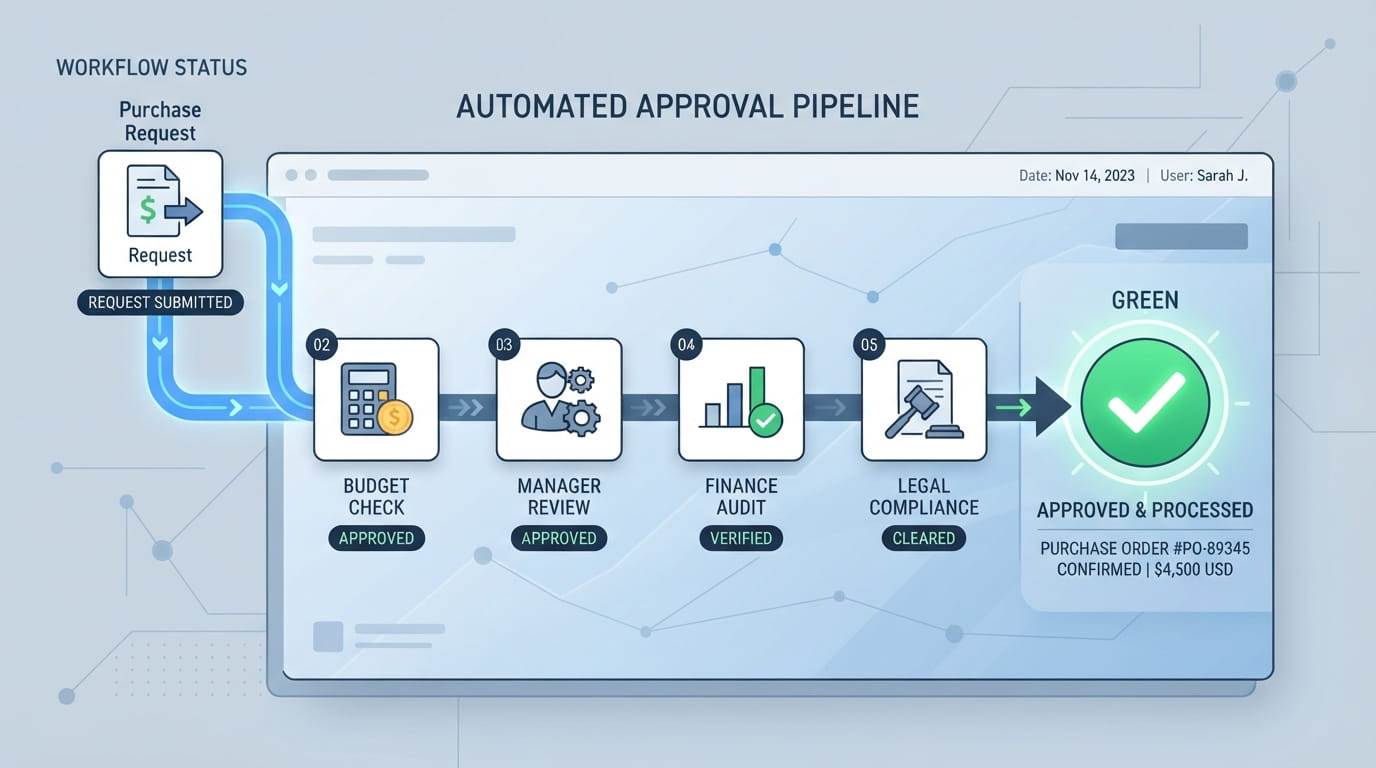
A purchase order that should take an afternoon is still taking weeks at most enterprises — split across a finance system, a contract repository, a supplier portal, and someone’s inbox. SaaS procurement automation is the software category built to close that gap, and 2026 is the year it stopped being a nice-to-have for large enterprises and started showing up in growth-stage buying stacks too — where a purchase order finally clears in hours instead of weeks.
What Is SaaS Procurement Automation?
SaaS procurement automation replaces manual purchase requests, approval chains, and vendor evaluation with software that routes requisitions, flags policy violations, and surfaces contract terms automatically. Instead of a purchase request sitting in an approver’s inbox for days, it applies pre-set thresholds so routine buys clear instantly while higher-risk or higher-spend requests escalate to a human reviewer with the relevant data already attached.
Why SaaS Procurement Automation Is Accelerating in 2026
Two pressures are pushing this category up the priority list this year. First, the market itself is scaling fast — the global procurement software category is on track to grow well past $10 billion in 2026, driven largely by AI-based approval and spend-analysis tools replacing spreadsheet-driven processes. Second, and more urgently, finance and IT teams are trying to close the same shadow-spend gap that’s driving broader SaaS vendor consolidation efforts — a large share of unmanaged software spend never touches procurement in the first place, and it’s the same pattern already being tackled through shadow AI spend governance programs. SaaS procurement automation is increasingly the mechanism that prevents that gap from reopening once a consolidation project is finished.
The Real Savings Behind SaaS Procurement Automation
The financial case for SaaS procurement automation is better documented than most infrastructure investments, because procurement data is easy to benchmark. Recent analysis of enterprise software spending data shows that companies who start vendor negotiations six months ahead of renewal save meaningfully more than those who wait until the last month — and SaaS procurement automation is what makes that lead time realistic at scale, since it’s the system tracking renewal dates and triggering the negotiation workflow automatically instead of relying on someone remembering a contract anniversary. Roughly a third of enterprise renewals still cluster in the fourth quarter, which is exactly the crunch that automated tracking is designed to prevent.
The same automation also closes a growing exposure point: usage-based vendor contracts, which now show significantly more spend variance than fixed-price contracts. Without SaaS procurement automation actively monitoring consumption against contracted volume, that variance shows up as a surprise on the invoice rather than a flagged risk weeks earlier — a gap that matters just as much to teams running enterprise SaaS sales motions on the selling side of these same usage-based deals.
How to Start SaaS Procurement Automation Without a Big Budget
Full-scale SaaS procurement automation platforms are built for large enterprise deployments, but the underlying discipline scales down. A growth-stage company can start with three things: a pre-approved vendor list, an automated spend-threshold alert on the corporate card and expense system, and a shared renewal calendar with a 90-day lookback trigger. None of that requires a six-figure platform — it requires someone owning the process. Companies that build this discipline early avoid the much larger cleanup project that SaaS vendor consolidation programs exist to solve later.
Strategic Outlook & Implementation
In my 10 years of experience as a Manager scaling technical infrastructure, procurement is the function that gets skipped longest and costs the most once it finally gets attention. I’ve watched growth-stage teams treat SaaS procurement automation as an enterprise-only concern, only to spend a painful quarter years later untangling forty vendors nobody tracked. My honest advice is to build the lightweight version of this discipline the moment a second department starts buying its own software, not when finance finally demands a full audit — a 90-day renewal trigger and a pre-approved vendor list cost almost nothing to set up and save real budget the first time they catch a renewal before it auto-renews at last year’s terms.
Conclusion
SaaS procurement automation in 2026 has moved from a large-enterprise efficiency play to a discipline every growing software buyer needs in some form. The organizations getting the most value from it aren’t necessarily the ones with the biggest platform — they’re the ones that treat renewal timing, spend visibility, and approval routing as a permanent operating habit rather than an annual cleanup project. Done consistently, SaaS procurement automation turns procurement from a reactive bottleneck into one of the more reliable sources of budget recovery a company has.
Frequently Asked Questions
Does SaaS procurement automation replace human approvers?
No — it routes low-risk purchases through automatically and escalates higher-spend or higher-risk requests to a human reviewer with the relevant context already attached.
Is SaaS procurement automation only for large enterprises?
No, though most full platforms are built for enterprise scale, the core discipline — pre-approved vendors, spend alerts, and renewal tracking — works for growth-stage teams with no dedicated platform at all.
How does SaaS procurement automation connect to vendor consolidation?
It’s the ongoing discipline that keeps a consolidated vendor list from re-sprawling, catching new unmanaged purchases before they accumulate into the next cleanup project.
About the Author
Hi, I’m Ghulam Fareed. Over the last 10 years as a Manager and Digital Growth Specialist, I’ve focused on scaling technical B2B SaaS properties and navigating complex architectures. My work sits at the intersection of enterprise finance, AI infrastructure strategy, and operational efficiency — helping organizations translate SaaS ambition into auditable, scalable, cost-effective outcomes. I write at SaaS Latest News to share frameworks that enterprise leaders can apply immediately, not just read and file away.