

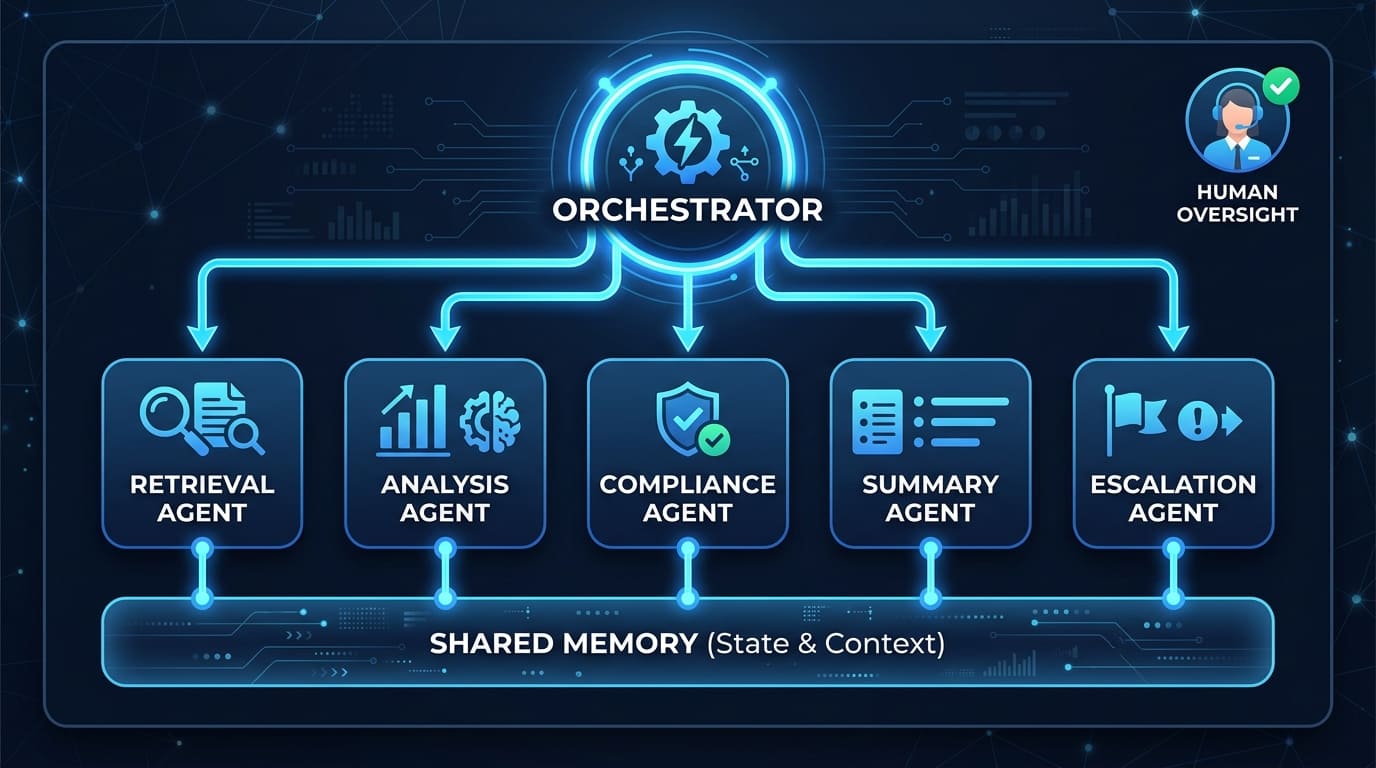
Multi-agent orchestration system design is the defining architectural challenge for enterprise AI teams in 2026. The first wave of enterprise AI followed a single-LLM pattern — one model, broad instructions, one context window. That pattern is breaking down under the weight of complex, cross-functional enterprise workflows that require specialized reasoning, parallel task execution, and coordination across systems that no single agent can manage efficiently or safely.
The shift is validated by data. A multi-agent research architecture using parallel sub-agents coordinated by a lead planner outperformed single-agent Claude Opus benchmarks by 90.2% in internal evaluations. Gartner projects that 40% of enterprise applications will embed AI agents by end of 2026. The agentic AI market is on a trajectory from $7.8 billion today to $52 billion by 2030. And the primary bottleneck in reaching that potential is not model capability — it is the orchestration design that determines whether multiple agents compound each other’s effectiveness or compound each other’s failures.
This guide provides the complete multi-agent orchestration system design framework for enterprise teams: the foundational concepts, the canonical architecture patterns mapped to use cases, the step-by-step build process, the framework selection criteria for 2026, the governance and observability requirements, and the failure modes that cause most enterprise multi-agent projects to stall between pilot and production.
Whether you are an AI architect designing the system, a CTO evaluating the investment, or an engineering team lead responsible for delivery — this is the reference document for building multi-agent systems that work in enterprise environments.
▶ [See our AI Architecture and Governance Framework]
| 90.2% Multi-agent vs single-agent performance uplift — internal Claude evaluations | 40% Enterprise apps embedding AI agents by end 2026 — Gartner | $52B Agentic AI market by 2030 from $7.8B today |
Multi-Agent Orchestration System Design: Foundations and Core Concepts
Multi-agent orchestration system design refers to the architectural discipline of coordinating multiple AI agents — each with specialized roles, tools, and context — to complete complex enterprise workflows that exceed the capability of any single agent. The value of orchestration emerges not from individual agent capability but from coordinated interaction: how agents share context, route tasks, validate each other’s outputs, and escalate to humans at the right decision points.
Understanding multi-agent orchestration requires clarity on four foundational concepts that distinguish it from single-agent and traditional workflow automation approaches.
Concept 1 — Specialization vs Generalization
The first principle of multi-agent system design is that specialized agents consistently outperform generalist agents on complex tasks. A single LLM tasked with end-to-end contract analysis — retrieving the document, identifying legal risks, checking compliance against policy, drafting a summary, and routing to the appropriate reviewer — produces mediocre results across all steps. Four specialized agents — retrieval, legal analysis, compliance check, and summary generation — each operating at high proficiency within their domain, produce superior overall outcomes.
The architectural implication: before designing orchestration, design specialization. Define the distinct reasoning domains required for your workflow. Assign one agent per domain. Build the orchestration layer to coordinate them, not to compensate for a single agent’s domain limitations.
Concept 2 — Orchestration vs Workflow Automation
Multi-agent orchestration is not workflow automation with AI labels. Traditional workflow automation follows predefined process rules — if X, trigger Y. Agent orchestration controls how AI agents reason, route tasks, use tools, share memory, validate outputs, and escalate issues. The distinction is that orchestration handles ambiguity: conditions that a deterministic workflow cannot anticipate, edge cases that require reasoning rather than rule-matching, and multi-step decisions where the correct path depends on the content of intermediate outputs.
Concept 3 — Context and Memory Architecture
Multi-agent systems face a context management challenge that single-agent systems do not: how does relevant information from one agent’s work become available to another agent that needs it, without flooding every agent with every other agent’s context and exhausting token budgets? Effective multi-agent orchestration design requires an explicit memory architecture that defines shared memory (visible to all agents), agent-local memory (scoped to one agent), episodic memory (session history), and semantic memory (long-term knowledge store). Designing this architecture before building is not optional — retrofitting memory management into a production multi-agent system is significantly more costly than designing it correctly from the start.
Concept 4 — Agent Identity and Permissions
Every agent in a multi-agent system must have a distinct identity with scoped permissions — not a shared credential that grants all agents equivalent access to all tools and data. The 2026 joint cybersecurity guidance on agentic AI specifies that agents should receive dedicated non-human identities with bounded permissions and revocable credentials. Agent identity is not only a security requirement — it is a prerequisite for meaningful audit trails, because accountability for any system action requires attributing that action to a specific, identifiable agent.
▶ [2026 Joint Cybersecurity Guidance on Agentic AI Deployment — cisa.gov]
Multi-Agent Orchestration System Design: The Five Canonical Architecture Patterns
The 2026 enterprise AI architecture research community has converged on a canonical set of multi-agent orchestration patterns that map consistently to specific enterprise use case categories. Selecting the wrong pattern for a given workflow is one of the most common and costly architectural mistakes — it produces systems that are either over-engineered for simple tasks or under-powered for complex ones. The following taxonomy maps each pattern to its optimal use case, risk profile, and framework support.
| Pattern | Topology | Best For | Risk Profile | Primary Framework |
| Supervisor-Worker | Central orchestrator + specialist workers | Complex regulated workflows needing central control and audit trail | Medium — single point of failure in orchestrator | CrewAI, AutoGen, OpenAI Agents SDK |
| Sequential Pipeline | Linear chain — output of A feeds B feeds C | Document processing, data transformation, report generation | Low — predictable failure modes, easy to debug | LangGraph, custom middleware |
| Parallel Fan-Out | Orchestrator dispatches to N concurrent agents; aggregates results | Research synthesis, market analysis, code review at scale | Medium — aggregation logic complexity | LangGraph, Microsoft Agent Framework |
| Debate / Critic | Multiple agents produce competing outputs; critic or vote resolves | Compliance review, risk assessment, high-stakes decisions | Low-Medium — higher token cost, slower | AutoGen, custom LangGraph |
| Adaptive Graph | Agents as nodes; dynamic routing based on output content | Complex open-ended workflows with variable paths | High — debugging difficulty, observability critical | LangGraph, Microsoft Agent Framework |
Pattern Selection Decision Rule
The orchestration pattern selection rule from Kore.ai’s April 2026 analysis is direct: the choice affects token consumption and cost by more than 200% depending on the number of reasoning iterations and coordination layers required. Pattern selection is not an aesthetic choice — it is a cost architecture decision with a direct impact on per-workflow operating expense and response latency.
- Use Supervisor-Worker for regulated enterprise environments where audit trail and central control are mandatory requirements
- Use Sequential Pipeline for deterministic document and data workflows where the task sequence is known in advance
- Use Parallel Fan-Out when tasks are genuinely independent and synthesis of parallel outputs adds value — do not parallelize interdependent tasks
- Use Debate/Critic for high-stakes decisions where the cost of a single-agent error exceeds the cost of multi-agent deliberation overhead
- Use Adaptive Graph only when workflow paths are genuinely variable and cannot be encoded in a static topology — the observability investment required is substantial
How to Build a Multi-Agent System for Enterprise Teams: Step-by-Step
The following eight-step process synthesizes the build methodology recommended by Codebridge, TrueFoundry, and Mak IT Solutions for enterprise multi-agent orchestration deployments. It is designed to be executed iteratively, with measurable checkpoints at each stage before proceeding to the next.
| Step | Phase | Action | Deliverable |
| 1 | Workflow Mapping | Map the target business process end-to-end. Identify every decision node, data source, and action type. Document where specialized reasoning is required vs where rule-based logic suffices. | Process map with AI-candidate task list |
| 2 | Agent Role Design | Define one agent per specialized reasoning domain. Write a role card for each agent: role name, input format, output format, tools available, and boundaries of authority. | Agent role registry with permission matrix |
| 3 | Pattern Selection | Select orchestration pattern from the canonical taxonomy based on workflow topology, regulatory requirements, and cost tolerance. Document selection rationale explicitly. | Architecture decision record (ADR) |
| 4 | Memory Architecture | Design shared memory schema, agent-local memory scope, episodic session history, and semantic knowledge store. Define what each agent can read and write. | Memory architecture specification |
| 5 | Tool and API Integration | Map each agent’s tool requirements. Implement middleware API layer with least-privilege scoping per agent. Configure identity and credentials per agent, not shared. | Permissioned tool registry per agent |
| 6 | Orchestration Build | Implement orchestration logic in selected framework. Build handoff protocols, context passing, output validation, and feedback loop between agents. | Working orchestration prototype |
| 7 | Observability Layer | Implement OpenTelemetry-first audit trail capturing every tool call, reasoning step, handoff, and output with agent ID and timestamp. Configure anomaly detection alerts. | Instrumented system with full audit trail |
| 8 | Pilot, Measure, Scale | Deploy in sandbox with a defined 30-day pilot scope. Measure latency, cost per run, task completion rate, and error rate. Gate scale decision on meeting pre-defined thresholds. | Pilot performance report with scale/no-scale decision |
The Pilot-First Rule
Mak IT Solutions’ 2026 enterprise deployment guidance is unambiguous on sequence: start with one measurable pilot before scaling agentic AI across departments. Most enterprise workflows start with three to seven agents — a simple system may need only an intake agent, retrieval agent, and response agent. Regulated workflows add compliance check, audit logging, fraud review, and human escalation agents. The pilot scope defines the minimum viable agent set for one specific workflow, not the full enterprise vision.
Organizations that design the full target architecture before validating a single workflow consistently over-engineer their systems and under-deliver on their pilots. The pilot-first rule produces systems that scale from evidence, not from assumption.
Framework Selection for Multi-Agent Orchestration System Design
Framework selection is a consequential decision that is difficult and expensive to reverse once a production system is built. The Q2 2026 agent architecture taxonomy from Digital Applied maps the canonical patterns to the leading frameworks with precision. The following comparison is designed for engineering teams making framework commitments for production multi-agent deployments.
| Framework | Language | Strongest Pattern Support | Enterprise Fit Notes |
| LangGraph | Python | Graph orchestration, plan-and-execute, supervisor-worker via subgraphs | Best for teams needing maximum flexibility; steeper learning curve; strong for adaptive graph pattern |
| AutoGen | Python | Supervisor-worker, debate/critic, swarm via group chat | Microsoft Research provenance; strong for multi-agent conversation patterns; good enterprise observability roadmap |
| CrewAI | Python | Supervisor-worker via crew/task metaphor, verifier-critic via task chains | Fastest time-to-prototype; role-based design maps naturally to enterprise team structures |
| OpenAI Agents SDK | Python | Handoff and tool calling, pipeline, graph via swarm reference | Native OpenAI model integration; best fit for GPT-5.x model families; limited model-agnosticism |
| Microsoft Agent Framework | .NET + Python | Graph orchestration, all canonical patterns | Strongest .NET enterprise integration; best fit for Microsoft 365 and Azure-standardized organizations |
| Framework Selection Principle — 2026 No single framework is optimal for all enterprise multi-agent use cases. LangGraph maximizes flexibility at the cost of development velocity. CrewAI maximizes development velocity at the cost of customization depth. AutoGen is strongest for debate and critic patterns. Framework selection should follow pattern selection, not precede it — choose the framework that best supports your chosen orchestration pattern, not the framework your team is most familiar with. |
Governance and Observability for Multi-Agent Orchestration System Design
The governance requirements for multi-agent systems are structurally more demanding than for single-agent deployments. In a single-agent system, a failure is attributable, containable, and recoverable. In a multi-agent system, a failure in one agent propagates through handoffs to downstream agents, potentially compounding across multiple reasoning steps before producing an observable error. The blast radius of a governance gap is larger, the attribution is more complex, and the recovery is more costly.
The Three Governance Non-Negotiables
The orchestration, governance, and observability mechanisms that sustain multi-agent system coherence, transparency, and accountability — as defined in the 2026 arxiv synthesis of orchestrated multi-agent system architectures — reduce to three non-negotiables for enterprise deployment.
- Agent-level attribution: every action taken in the system must be attributable to a specific, identified agent. Not to the system, not to the workflow, not to the model — to a named agent with a defined role and scoped permissions. Without agent-level attribution, incident investigation is impossible and accountability is theoretical.
- Cross-agent context integrity: when an agent hands off to another agent, the receiving agent must receive exactly the context it needs — no more, no less. Overly broad context passing inflates token costs and risks leaking information between agents with different permission scopes. Insufficient context passing degrades output quality. Context passing specification is a first-class engineering artifact, not an implementation detail.
- Human escalation that actually works: multi-agent systems that escalate to human reviewers but do not receive timely human responses default to continuing execution — which means the escalation is not functioning as a governance control. Human escalation protocols must specify response SLAs, define agent behavior during escalation pending periods, and name accountable reviewers by role and backup chain.
Observability as the Control Plane
The Arthur.ai 2026 Agentic AI Observability Playbook positions observability as the control plane of multi-agent systems — the mechanism that transforms autonomous multi-agent behavior into measurable, auditable, improvable outcomes. For multi-agent orchestration specifically, the observability requirements extend beyond single-agent monitoring to cover the coordination layer: handoff events, context transfer content, cross-agent dependency chains, and the reasoning steps that led an orchestrator to select a specific worker agent for a task.
The minimum observability standard for production multi-agent systems in 2026 is OpenTelemetry-first instrumentation, capturing every tool call with agent ID and timestamp, every handoff event with context payload, and every orchestration decision with the reasoning trace that produced it. This data must be stored in a tamper-evident format, queryable by compliance teams, and linked to business KPI outcomes for executive reporting.
Conclusion: Multi-Agent Orchestration System Design Is Now an Enterprise Engineering Discipline
Multi-agent orchestration system design has graduated from research prototype to production engineering discipline in 2026. The performance evidence — 90.2% uplift over single-agent baselines — validates the architectural investment. The market trajectory — from $7.8 billion to $52 billion by 2030 — validates the strategic priority. The governance requirements — agent identity, context integrity, human escalation, and observability — define the engineering rigor required to make that investment deliver rather than disappoint.
The enterprises building multi-agent orchestration systems correctly in 2026 are following a consistent pattern: specialization before orchestration, pattern selection before framework selection, pilot before scale, and observability as infrastructure not afterthought. The enterprises stalling on this capability are consistently making the inverse mistakes — building orchestration before defining specialization, selecting frameworks before selecting patterns, and deploying to production before building governance infrastructure.
Immediate actions for enterprise engineering and architecture teams:
- Map one high-value enterprise workflow against the eight-step build process this sprint — identify which step is the current blocker and address it specifically.
- Select your orchestration pattern from the canonical taxonomy before selecting a framework — the pattern decision drives the framework decision, not vice versa.
- Design agent role cards and the agent permission matrix before writing any orchestration code — these artifacts are the specification the code must implement.
- Design the memory architecture explicitly — define shared memory schema, agent-local scope, and context passing protocols before building handoff logic.
- Instrument observability at the orchestration layer, not just the agent layer — handoff events, context transfers, and orchestration decisions are the data your governance and optimization programs depend on.
- Gate your scale decision on pilot performance data — define the latency, cost, completion rate, and error rate thresholds that must be met before expanding to additional workflows or departments.
Multi-agent orchestration is not the end state of enterprise AI architecture. It is the current frontier — the capability boundary where enterprise teams are building genuine workflow intelligence rather than deploying sophisticated autocomplete. The organizations that master it now are building a compounding architectural advantage that their competitors will spend years trying to replicate.
Frequently Asked Questions (FAQs)
Q1: What is multi-agent orchestration system design?
Multi-agent orchestration system design is the architectural discipline of coordinating multiple AI agents — each with specialized roles, tools, and context — to complete complex enterprise workflows that exceed the capability of any single agent. It covers the topology of agent relationships (how agents communicate and hand off tasks), the patterns governing coordination (supervisor-worker, pipeline, parallel, debate, graph), the memory architecture enabling context sharing, the permission model scoping each agent’s access, and the observability infrastructure making the system auditable and improvable. It is distinct from traditional workflow automation because it handles ambiguity — conditions that deterministic rule-based systems cannot anticipate.
Q2: What are the main multi-agent orchestration patterns for enterprise use?
The five canonical enterprise multi-agent orchestration patterns in 2026 are: Supervisor-Worker (centralized orchestrator coordinating specialist workers — best for regulated environments requiring audit trail); Sequential Pipeline (linear chain where agent outputs feed the next agent — best for document and data processing); Parallel Fan-Out (orchestrator dispatches concurrent agents and aggregates results — best for research synthesis and analysis); Debate/Critic (multiple agents produce competing outputs resolved by a critic agent — best for high-stakes decisions); and Adaptive Graph (dynamic routing between agents based on output content — best for open-ended workflows with variable paths). Pattern selection affects token cost by more than 200% across options.
Q3: How many agents should a typical enterprise multi-agent system start with?
Most enterprise workflows start with three to seven agents. A minimal viable system may need only an intake agent, retrieval agent, and response agent. Regulated workflows typically add compliance check, audit logging, fraud review, and human escalation agents. The pilot-first principle is critical: define the minimum viable agent set for one specific workflow, validate it fully, and expand based on performance evidence. Systems designed for the full enterprise vision before a single workflow is validated consistently over-engineer their architecture and under-deliver on their pilots.
Q4: What is the difference between multi-agent orchestration and workflow automation?
Workflow automation follows predefined process rules — if X, trigger Y — and cannot handle conditions outside its encoded rules. Multi-agent orchestration controls how AI agents reason, route tasks dynamically based on content, use tools contextually, share memory across execution steps, validate each other’s outputs, and escalate issues to humans based on reasoning rather than rule-matching. The fundamental difference is the handling of ambiguity: multi-agent systems can navigate conditions that a deterministic workflow cannot anticipate, making them appropriate for complex enterprise tasks where the correct path depends on the content of intermediate outputs.
Q5: Which framework should I choose for enterprise multi-agent orchestration?
Framework selection should follow pattern selection, not precede it. LangGraph is strongest for adaptive graph patterns and maximum flexibility, at the cost of development velocity. CrewAI offers the fastest prototype-to-production path with role-based design that maps naturally to enterprise team structures. AutoGen is strongest for debate and critic patterns and multi-agent conversation scenarios. The OpenAI Agents SDK is the best fit for GPT-5.x model families with native handoff and tool calling support. Microsoft Agent Framework is strongest for .NET enterprise environments standardized on Azure. Teams standardized on Microsoft tooling should evaluate the Microsoft Agent Framework before investing in Python-native alternatives.
Q6: How do you handle memory and context sharing in multi-agent systems?
Memory architecture in multi-agent systems requires explicit design across four scopes: shared memory (visible to all agents, typically used for workflow state and key outputs), agent-local memory (scoped to a single agent’s execution, not accessible to others), episodic memory (session history enabling agents to reference prior steps), and semantic memory (long-term knowledge store enabling agents to access organizational knowledge). Context passing between agents during handoffs must be specified as a first-class engineering artifact — defining exactly what context the receiving agent requires, not defaulting to passing full conversation history, which inflates token costs and risks information scope violations.
Q7: What governance requirements apply to enterprise multi-agent systems?
Enterprise multi-agent systems require three governance non-negotiables: agent-level attribution (every action attributable to a specific, identified agent with a named role and scoped permissions), cross-agent context integrity (context passing protocols that give receiving agents exactly what they need without over-sharing), and functional human escalation (protocols with named accountable reviewers, defined response SLAs, and specified agent behavior during pending escalation periods). Additionally, compliance-mapped observability — capturing every tool call, handoff, and orchestration decision in a tamper-evident audit trail linked to business KPIs — is the production governance standard for 2026.
Q8: How do you measure success for a multi-agent orchestration pilot?
A multi-agent orchestration pilot should be measured against five metrics defined before deployment: task completion rate (percentage of workflow runs completed without human intervention or error), end-to-end latency (time from workflow initiation to final output, measured against baseline), cost per run (total token and API consumption per workflow execution, measured against budget model), error rate (percentage of runs requiring human correction or producing incorrect outputs), and quality score (human evaluator rating of output quality on a defined rubric). Gate the scale decision on meeting pre-defined thresholds across all five metrics — not on any single metric in isolation.
| About the Author Ghulam Fareed Ghulam Fareed is a Technical SEO Specialist and Digital Strategist with a focus on B2B SaaS architecture. He writes for enterprise technology leaders, AI architects, and engineering teams building production-grade agentic AI systems. |
| Published for an international enterprise engineering and executive audience (US & Global) | saaslatestnews.com.com |