

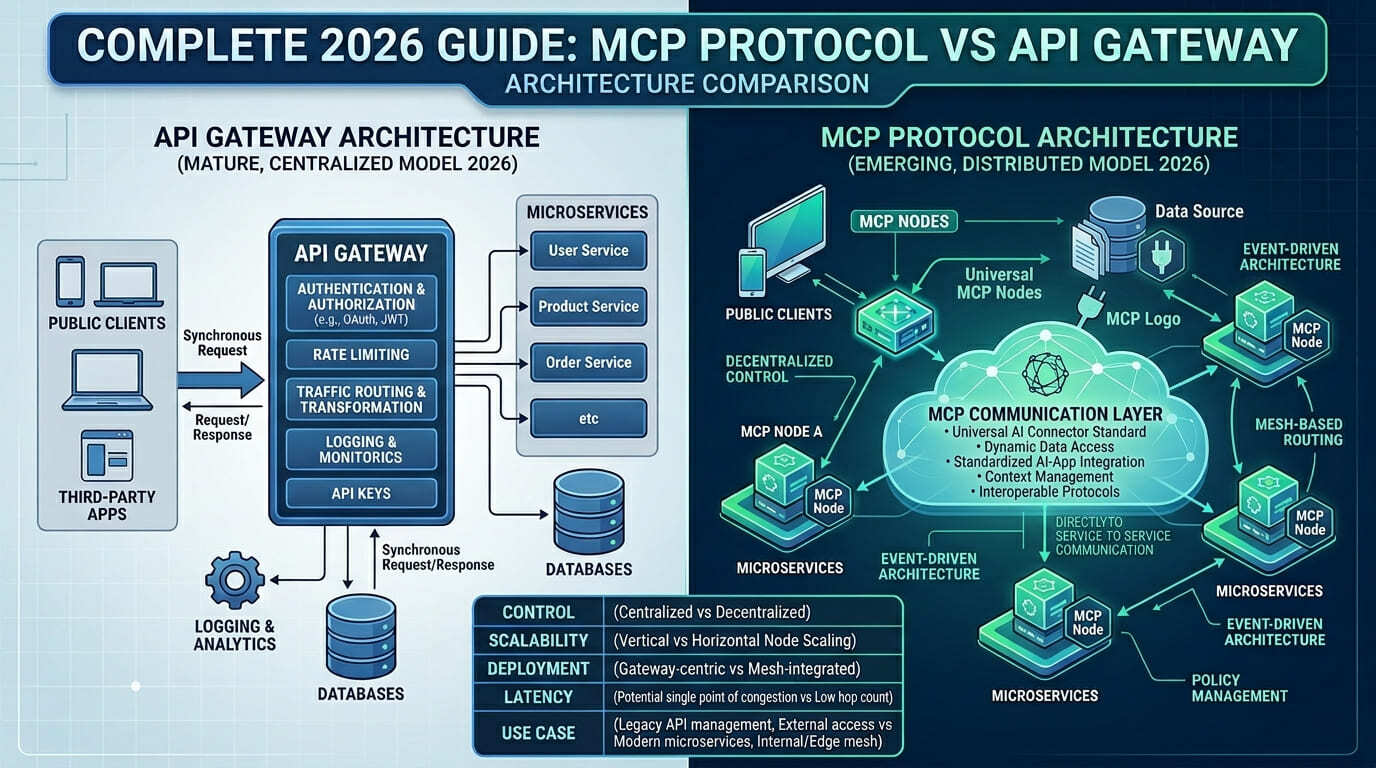
MCP Protocol vs API Gateway: Complete 2026 Guide is the most important infrastructure decision facing enterprise AI architecture teams in 2026. The Model Context Protocol has moved from a November 2024 Anthropic specification to the de facto standard for AI agent tool integration in under eighteen months — recording 97 million SDK downloads, crossing 10,000 enterprise server implementations, and achieving 78% adoption among production AI teams.
The question enterprise teams are asking is not which one to choose. It is whether they understand the architectural boundary between them precisely enough to deploy both correctly. Getting this wrong — retrofitting a traditional API gateway to serve MCP traffic, or using a raw MCP server without a gateway control plane — is the architecture mistake that drives the 86 to 89% AI agent pilot failure rate Gartner records for production deployments in 2026.
MCP Protocol vs API Gateway: Complete 2026 Guide for Enterprise Architecture Teams decision: the fundamental architectural differences, a head-to-head comparison across nine evaluation criteria, the security threat landscape each addresses, the enterprise MCP gateway market with pricing in both USD and GBP, the migration path for teams moving from API-first to MCP-first AI integration, and the use-case matrix for when you need each — or both.
| 97M MCP SDK downloads by April 2026 | 78% Production AI team MCP adoption rate | 10K+ Enterprise MCP server implementations | 86% AI agent pilot failure rate without gateway governance — Gartner |
MCP Protocol vs API Gateway: Architectural Fundamentals
MCP Protocol vs API Gateway: Complete 2026 Guide starts with one essential clarification — these two technologies are not competing solutions. They are complementary infrastructure layers designed for different consumers, different session models, and different threat landscapes
What Is a Traditional API Gateway?
An API gateway is a reverse proxy that sits between clients and backend services, providing centralised authentication, rate limiting, routing, load balancing, caching, observability, and protocol translation for HTTP-based application traffic. The clients it serves are applications — web frontends, mobile apps, microservices, third-party integrations — that make stateless, deterministic, developer-authored requests to defined endpoints.
The API gateway assumes a request-response model: a client calls a specific URL, the gateway validates and routes the request, the backend responds, and the interaction is complete. The gateway has no concept of session state beyond authentication tokens, no understanding of the semantic meaning of the request, and no ability to help the caller discover available capabilities dynamically. These are not limitations — they are appropriate design choices for the consumer the gateway serves.
What Is the MCP Protocol?
The Model Context Protocol is an open standard introduced by Anthropic in November 2024 and donated to the Linux Foundation’s Agentic AI Foundation in December 2025. It standardises how AI agents — large language models, autonomous agents, agentic workflows — connect to external tools, APIs, and data sources. Where an API gateway routes requests from applications, an MCP server exposes capabilities to AI reasoning engines.
The architecture uses JSON-RPC 2.0 messages transported over HTTP with Server-Sent Events for streaming, or stdio for local development. Three capability types are exposed: Tools (executable functions the AI decides to call), Resources (read-only data entities providing context), and Prompts (standardised interaction templates). The critical distinction from REST APIs is statefulness: an MCP server maintains session state across multi-turn agent interactions, enabling the agent to chain tool calls, maintain context between them, and build on intermediate results within a single session.
| ★ The Core Architectural Difference APIs are for software calling software — deterministic, stateless, developer-authored. MCP is for AI reasoning about what to call, when, and in what sequence — probabilistic, stateful, agent-authored. The gateway that governs one is not the gateway that governs the other. |
→ [The New Stack — MCP vs API Gateways: They’re Not Interchangeable — thenewstack.io]
MCP Protocol vs API Gateway: Head-to-Head Comparison Across Nine Dimensions
| Dimension | API Gateway | MCP Protocol / MCP Gateway | 2026 Verdict |
| Primary Consumer | Applications — web, mobile, microservices | AI agents — LLMs, autonomous agents, agentic workflows | Each owns its lane |
| Session Model | Stateless — every request independent | Stateful — server maintains session across multi-turn calls | MCP for agents |
| Tool Discovery | Static — developer pre-codes every endpoint | Dynamic — agent discovers available tools at runtime | MCP clearly |
| Context Handling | None — no cross-call context persistence | Native — context maintained across chained tool calls | MCP clearly |
| Transport | HTTP REST, GraphQL, gRPC | JSON-RPC 2.0 / HTTP+SSE / stdio | Different purposes |
| Threat Model | SQL injection, DDoS, auth bypass, data exfiltration | Tool poisoning, prompt injection, rug pull, cross-server shadowing | MCP needs specialist GW |
| Observability Maturity | Very high — decades of tooling, OpenTelemetry native | Maturing — requires purpose-built MCP gateway layer | API GW leads today |
| Enterprise Compliance | Mature — GDPR, HIPAA, SOC 2, ISO 27001 tooling available | Emerging — SOC 2 available via managed gateways | API GW leads today |
| AI Workflow Fit | Poor — stateless model mismatches agent interaction patterns | Purpose-built — designed for agentic reasoning workflows | MCP definitively |
The head-to-head table confirms the conclusion that The New Stack’s March 2026 analysis reached and that TrueFoundry, MCP Manager, and Obot have each independently validated: MCP and API gateways are not interchangeable. They serve different consumers, operate on different session models, face different threat vectors, and solve different integration problems. The architecture question is not either-or — it is where each belongs in your stack.
MCP Protocol vs API Gateway: The Security Threat Landscape in 2026
The MCP Protocol vs API Gateway security distinction is where the architectural choice becomes operationally critical. Traditional API gateways were hardened against decades of known HTTP attack vectors. MCP introduces an entirely new category of protocol-level threats that generic API gateways were not designed to detect or prevent. The April 2025 security research that identified multiple outstanding MCP security issues remains relevant in 2026, and enterprise teams deploying MCP without purpose-built gateway controls are accepting attack surface that their existing API security tooling cannot address.
| Threat Vector | API Gateway Coverage | MCP-Specific Gateway Required |
| SQL Injection | Full coverage — validated and blocked at gateway | Not MCP-specific — standard input validation covers |
| DDoS / Rate Abuse | Full coverage — rate limiting, throttling, IP blocking | MCP gateway adds per-tool-call rate limits specific to agent patterns |
| Auth Bypass | Full coverage — OAuth, JWT, API key validation | MCP gateway adds per-user identity propagation — not shared service key |
| Tool Poisoning | Not covered — API GW has no tool semantic understanding | MCP gateway required — inspects tool definitions before agent exposure |
| Prompt Injection via Tool Response | Not covered — API GW cannot parse LLM-targeted payloads | MCP gateway required — Lasso-class real-time payload inspection |
| Rug Pull (Tool Redefinition) | Not covered — no concept of tool identity in API GW | MCP gateway required — tool identity pinning and change detection |
| Cross-Server Shadowing | Not covered — no multi-server tool namespace awareness | MCP gateway required — centralized tool registry with namespace isolation |
| Data Exfiltration via Tool Chaining | Partial — can inspect individual request payloads | MCP gateway required — cross-call context inspection to detect exfil patterns |
| Credential Theft via MCP Server | Partial — credential governance at HTTP level only | MCP gateway required — per-agent virtual keys, vault integration, rotation |
The security threat matrix confirms the finding from Lasso Security’s 2026 analysis: MCP introduces attack surface that legacy infrastructure does not cover. Tool poisoning, prompt injection via tool responses, rug pull attacks, and cross-server shadowing are entirely new threat categories with no precedent in the API gateway security playbook. Enterprise security teams that do not add a purpose-built MCP gateway before production deployment are deploying AI agents into an unmonitored security perimeter.
MCP Protocol vs API Gateway: The 2026 MCP Gateway Market — Pricing in USD and GBP
The MCP Protocol vs API Gateway market analysis shows five distinct enterprise gateway categories. Pricing is presented in both USD for US teams and GBP for UK teams at the May 2026 reference rate of £1 ≈ $1.27. UK teams should apply 20% VAT to cloud software subscriptions from non-UK vendors under UK digital services tax rules — factor this into total cost of ownership calculations.
| Gateway | Best For | US Price | UK Price (ex-VAT) | Governance Depth |
| Bifrost (OSS) | Teams needing sub-microsecond overhead with full MCP support + governance | Free (self-hosted) | Free (self-hosted) | Very High |
| Bifrost Enterprise | Regulated enterprises needing in-VPC, Vault, RBAC, clustering | Custom — contact sales | Custom | Enterprise |
| Kong AI Gateway | Orgs already running Kong for REST/gRPC wanting unified control plane | ~$250/mo (Konnect) | ~£197/mo | High |
| Cloudflare MCP | Edge-native deployment, Cloudflare One stack users | $20/mo (Workers Pro) | £16/mo | Medium |
| MintMCP (Managed) | SOC 2 / HIPAA-certified managed gateway, regulated sectors | $49–$299/mo | £39–£236/mo | High |
| Apigee (Google) | Google Cloud-native; zero-code MCP from OpenAPI spec | From $560/mo | From £441/mo | High |
| Lasso Security | Security-sensitive environments, active AI threat detection | Open source core | Open source core | Security-First |
| TrueFoundry | Only Gartner-recognised AI Gateway Platform vendor (2025 Market Guide) | Enterprise pricing | Enterprise pricing | Highest |
| Obot (OSS) | Open-source Kubernetes-native, full data sovereignty, no license cost | Free (self-hosted) | Free (self-hosted) | High |
| Tyk AI Studio | Go-based open source; MCP toolchain plugin; strong REST+MCP unification | Free (CE) | Free (CE) | Medium-High |
| ★ Gateway Selection Decision Rule — 2026 If you are already running Kong for REST and gRPC traffic, extend it to MCP rather than introducing a new vendor — the consolidation value is real. If you have no existing API gateway investment, Bifrost delivers the strongest combination of performance, governance, and open-source transparency for teams starting fresh. For regulated industries in the UK (FCA, NHS Digital, ICO-regulated data) or US (HIPAA, FedRAMP), MintMCP’s managed SOC 2 Type II gateway or TrueFoundry’s Gartner-recognised platform eliminates compliance buildout overhead. Lasso is the correct first choice when AI-specific threat detection — tool poisoning, prompt injection, rug pull — is the primary security concern. |
MCP Protocol vs API Gateway: When Your Enterprise Needs Both
The answer to the MCP vs API gateway question for most production enterprise environments in 2026 is both — deployed as complementary layers handling different traffic types. The integration architecture that the enterprise teams achieving the strongest AI outcomes are building in 2026 follows a clean separation of concerns.
Application Traffic Layer — API Gateway
Your existing API gateway handles what it was built for: application-to-application communication, developer-authored REST integrations, external partner API traffic, mobile backend requests, and inter-service communication. Kong, Apigee, AWS API Gateway, Azure API Management, Tyk — these tools have been hardened for decades against the threat vectors of HTTP application traffic. They handle authentication, rate limiting, routing, caching, and observability for this traffic class with mature, well-understood tooling.
AI Agent Traffic Layer — MCP Gateway
Your MCP gateway handles what the API gateway cannot: stateful, multi-turn, agent-driven tool interactions. Every tool call from every AI agent flows through the MCP gateway’s control plane — authentication via per-agent virtual keys, tool-level access control via allow-lists and role-based filtering, real-time threat detection against AI-specific attack vectors, immutable audit trails for compliance, and circuit-breaking for runaway agent sessions.
The Unified Control Plane Opportunity
For enterprises that prefer platform consolidation over point solutions, Kong AI Gateway and Tyk AI Studio offer a path to unified governance of both REST API traffic and MCP tool traffic on a single control plane. This architecture is operationally attractive — one identity model, one observability stack, one governance team — but requires validating that the chosen platform’s MCP support is native rather than retrofitted. Kong’s MCP support is enterprise-only with paid plugins; Tyk’s MCP support launched in March 2026 and is maturing. Teams evaluating unified platforms should specifically test MCP-specific threat detection capabilities — tool poisoning and rug pull protection are the differentiators that separate MCP-native gateways from API gateways that added MCP support as a feature.
Migration Path: From API-First to MCP-First AI Integration
For enterprise teams with significant existing API gateway investment, the migration to MCP-first AI integration does not require replacing existing infrastructure. It requires adding the MCP layer alongside it and defining the routing logic that determines which traffic class each gateway handles.
Phase 1 — Inventory and Classify
Audit every enterprise tool, API, and data source that your AI workflows currently access through custom integrations or raw API calls. Classify each by traffic type: application traffic (stays on API gateway), AI agent traffic (moves to MCP). Most integrations accessed by AI agents in your current stack are candidates for MCP server wrapping — this is the core N×M to N+M reduction that MCP delivers.
Phase 2 — Pilot MCP Server Build
Build MCP servers for your three highest-value AI integration targets. For REST APIs with OpenAPI specifications, Apigee’s zero-code MCP generation from API specs eliminates most of the development work. For complex enterprise systems (Salesforce, SAP, ServiceNow), budget two to four weeks per MCP server. UK teams using contract engineers for MCP server development: senior AI/API engineers charge £450–£900 per day; budget eight to sixteen contractor days per complex enterprise MCP server at market rates. US teams: equivalent rates run $575–$1,150 per day for senior AI engineers with MCP experience in 2026.
Phase 3 — Deploy MCP Gateway Control Plane
Before any MCP server goes to production, deploy your MCP gateway. For teams new to MCP, deploy Bifrost via Docker in 30 seconds as your first control plane — operational experience accelerates every subsequent decision. Define tool allow-lists for each agent, configure per-agent virtual keys, activate OpenTelemetry tracing. The governance architecture must precede production deployment, not follow it.
Phase 4 — Route AI Agent Traffic
Redirect AI agent tool calls from raw API endpoints to the MCP gateway. For agents that were previously calling REST endpoints directly, this is the architectural step that adds stateful context, dynamic tool discovery, and centralized governance. Measure the performance difference: MCP gateways add minimal overhead — Bifrost runs at sub-microsecond per-call overhead, well within acceptable latency budgets for agentic workflows.
Conclusion: MCP Protocol vs API Gateway Is Not a Competition — It Is an Architecture
The MCP Protocol vs API Gateway question has a clear 2026 answer: they are complementary layers of enterprise infrastructure, not competing solutions. API gateways govern application traffic. MCP gateways govern AI agent traffic. The enterprises building durable AI systems in 2026 understand this boundary precisely and invest in purpose-built governance for each traffic type.
The 86 to 89% AI agent pilot failure rate that Gartner records for production deployments is not primarily a model capability problem. It is a governance architecture problem — agents deployed without MCP gateway controls, without per-agent identity, without tool-level access control, without AI-specific threat detection, and without immutable audit trails. Every one of those gaps is closed by a production-grade MCP gateway, and none of them is closed by a traditional API gateway retrofitted for MCP traffic.
Immediate actions for enterprise architecture and security teams:
- Audit your current AI agent integrations and identify every tool access that bypasses a governed control plane — these are your immediate MCP gateway deployment targets.
- Deploy Bifrost or Obot in a sandbox environment this sprint — 30-second Docker setup gives your team immediate operational familiarity with MCP gateway architecture.
- Define your per-agent tool allow-lists before connecting any agent to a production MCP server — the governance architecture precedes the capability deployment.
- For UK teams: assess FCA digital operational resilience, ICO AI guidance, and UK GDPR Article 30 requirements for your MCP gateway selection — managed SOC 2 solutions reduce compliance buildout cost materially.
- For US teams in regulated sectors: HIPAA BAA availability and FedRAMP authorization should be first-pass filters in your MCP gateway evaluation — MintMCP and TrueFoundry are the clearest options in this category today.
- Evaluate Kong AI Gateway or Tyk AI Studio if platform consolidation (REST + MCP on one control plane) is your architectural priority — validate MCP-native threat detection capabilities before committing.
The enterprises that master this architecture boundary in 2026 are building the AI infrastructure layer that compounds. The enterprises that skip it are building the conditions for their most public AI failure.
Frequently Asked Questions (FAQs)
Q1: What is the difference between MCP Protocol and an API Gateway?
An API gateway is a reverse proxy that manages stateless HTTP application traffic — routing, authentication, rate limiting, and observability for requests from applications (web, mobile, microservices). An MCP (Model Context Protocol) server and gateway manage stateful, multi-turn, AI agent traffic — enabling AI agents to dynamically discover tools, chain tool calls with persistent context, and interact with enterprise systems through a standardised protocol. The fundamental architectural difference is the consumer: API gateways serve applications making deterministic, developer-authored calls; MCP gateways serve AI agents making probabilistic, reasoning-driven tool decisions. In production enterprise environments, most teams need both, handling different traffic classes on appropriate infrastructure.
Q2: Can an existing API gateway replace an MCP gateway?
No. Traditional API gateways were not built for MCP’s session model, tool discovery model, or threat landscape. MCP introduces stateful multi-turn interactions that API gateways cannot track, dynamic tool discovery that API gateways have no concept of, and AI-specific threat vectors — tool poisoning, prompt injection via tool responses, rug pull attacks, cross-server shadowing — that API gateway threat models do not address. The New Stack, TrueFoundry, MCP Manager, and Obot all reach the same conclusion in their 2026 analyses: MCP and API gateways are not interchangeable, and teams that attempt to use an API gateway for MCP traffic end up with scattered credentials, no telemetry, and zero visibility into agent behaviour.
Q3: What is tool poisoning in MCP and why can’t API gateways stop it?
Tool poisoning is a MCP-specific attack in which a malicious or compromised MCP server presents a tool definition designed to manipulate the AI agent’s reasoning — causing it to take actions outside its intended scope, exfiltrate data through apparently legitimate tool calls, or override the agent’s safety constraints through crafted tool metadata. API gateways cannot detect or block tool poisoning because they have no understanding of MCP tool semantics — they inspect HTTP headers and payloads, not the meaning of tool definitions presented to an AI reasoning engine. Purpose-built MCP gateways with tool identity pinning, tool definition change detection, and parameter validation address this attack vector directly.
Q4: How much does an enterprise MCP gateway cost in the US and UK?
Open-source self-hosted options — Bifrost, Obot, Tyk AI Studio CE, ContextForge — are free, with infrastructure costs of approximately $80–$400 per month ($63–£315 GBP equivalent) depending on configuration and redundancy. Managed solutions range from Cloudflare Workers Pro at $20/month (£16/month excluding UK VAT) to MintMCP at $49–$299/month (£39–£236/month), Kong AI Gateway from approximately $250/month (£197/month), and Apigee from $560/month (£441/month). Enterprise managed options including TrueFoundry and Bifrost Enterprise are custom-priced. UK teams should add 20% VAT to all software subscriptions from non-UK vendors and factor contract engineer rates of £450–£900 per day for MCP server development alongside gateway costs.
Q5: Which MCP gateway is best for regulated industries in the US and UK?
For US regulated industries: MintMCP’s SOC 2 Type II managed gateway and TrueFoundry’s Gartner-recognised AI Gateway platform are the clearest choices for HIPAA-covered entities and organisations requiring FedRAMP-aligned architecture. Bifrost Enterprise with in-VPC deployment and HashiCorp Vault integration is the strongest open-source option for teams with FedRAMP or DoD cloud requirements. For UK regulated industries: FCA-regulated financial services firms should prioritise gateways with SOC 2 Type II or ISO 27001 certification and UK GDPR Article 30-compliant audit trail capabilities. MintMCP and TrueFoundry both satisfy these requirements. NHS Digital and ICO-regulated organisations should additionally validate that their MCP gateway can be deployed within UK data residency constraints — in-VPC or UK-region managed deployments are required for most NHS Digital frameworks.
Q6: Does MCP replace REST APIs?
No. MCP does not replace REST APIs — it wraps them. MCP servers typically expose REST API capabilities to AI agents through a standardised MCP interface, without requiring the underlying APIs to be rebuilt. The enterprise integration architecture remains REST for application-to-application traffic. MCP adds an AI-accessible layer on top, enabling agents to discover and use those capabilities without custom connectors. Traditional REST APIs continue to process approximately 92% of organisational data exchanges, according to 2026 integration research. MCP handles the AI agent interaction layer above that foundation. In most enterprise AI architectures, you need both the REST layer and the MCP layer, with appropriate gateways governing each.
Q7: What is the N×M problem in AI integration and how does MCP solve it?
The N×M problem is the integration sprawl that results from connecting N AI models to M enterprise tools without a standardised protocol. Without MCP, each model requires a custom connector for each tool — ten models connecting to fifty tools produces five hundred separate integration points, each requiring independent development, security review, credential management, and maintenance. MCP eliminates this by establishing a universal standard: any MCP-compliant agent connects to any MCP-compliant server without custom connectors. The integration count drops from N×M to N+M — ten models and fifty MCP servers requires sixty integrations rather than five hundred. This architectural simplification is the foundational business case for MCP adoption and explains the 78% production adoption rate among enterprise AI teams as of May 2026.
Q8: When should an enterprise start deploying MCP alongside their existing API gateway?
The trigger for MCP deployment is the first AI agent that needs to access enterprise tools in a production environment. If your AI agents are accessing any enterprise system — a database, a CRM, a document store, a workflow platform — through a raw API call or a custom connector without a governed MCP control plane, you already have an unmanaged MCP deployment risk. The correct sequencing: define your agent use cases and tool access requirements, select an MCP gateway before any MCP server goes to production, build your first two to three MCP servers for highest-value integrations, and measure the governance improvement before expanding. Start with Bifrost for speed of deployment or TrueFoundry for compliance-first environments. Both can be operational alongside your existing API gateway infrastructure without requiring any changes to your REST API layer.
| About the Author Ghulam Fareed is a Technical SEO Specialist and Digital Strategist with a focus on B2B SaaS architecture. He writes for enterprise technology leaders, AI architects, and engineering teams building production-grade agentic AI systems for US, UK, and global enterprise environments. https://saaslatestnews.com/ |
| latestsaasnews.com | Published for US · UK · Global Audiences | © 2026 Ghulam Fareed |