

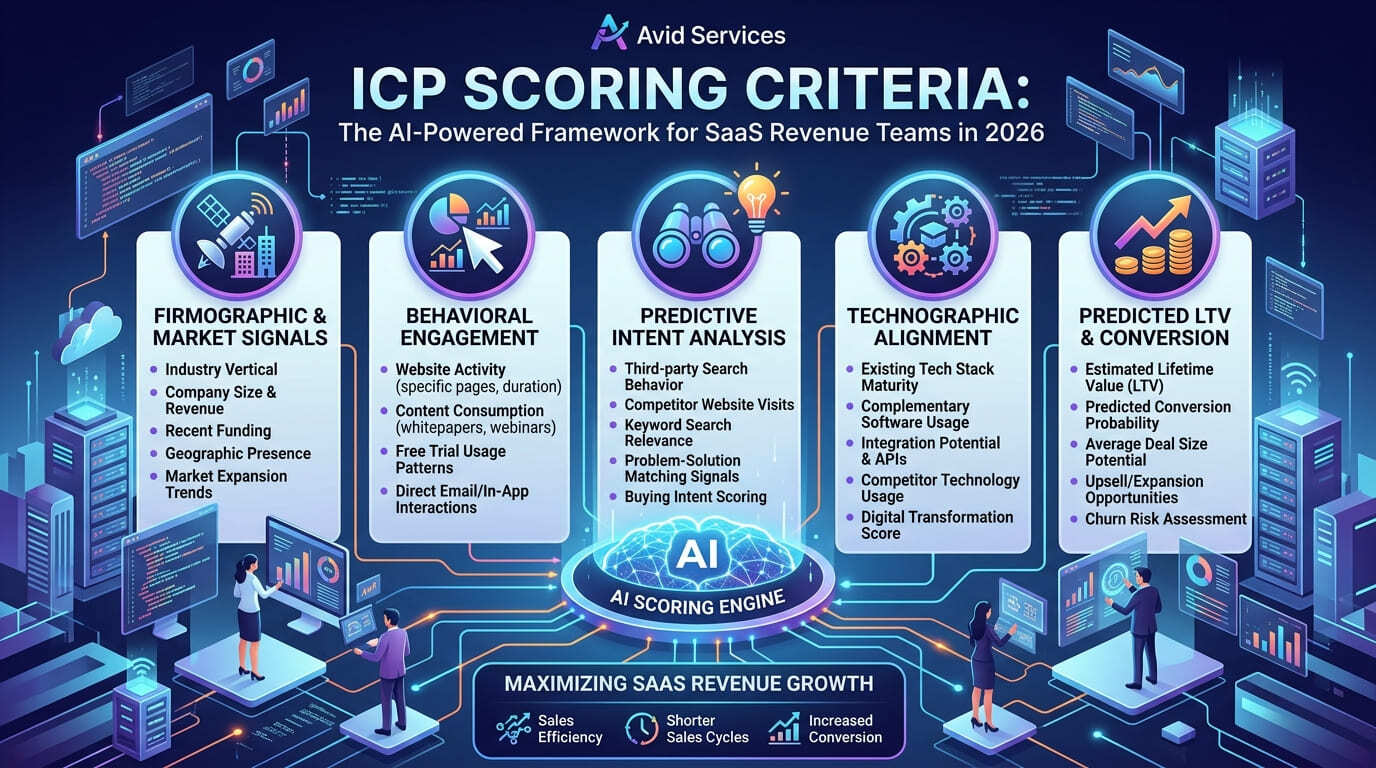
Avid services ICP scoring criteria represent the most consequential upgrade available to B2B SaaS revenue organizations in 2026. The Ideal Customer Profile has existed as a concept for decades. What has changed fundamentally is the sophistication with which the leading avid services platforms now define, score, automate, and operationalize ICP criteria — moving the discipline from a static marketing persona into a real-time, AI-driven revenue engine that determines which accounts get AE attention, which enter automated nurture, and which are disqualified before they waste a single SDR hour.
The commercial case is unambiguous. Deals sourced from ICP-fit accounts close at 68% versus 22% for non-fit accounts, with sales cycles 20 to 30% shorter — according to Cleanlist’s 2026 customer data across B2B SaaS cohorts. GrowthSpree’s ICP scoring data for paid media shows MQL-to-SQL conversion rates jumping from 13% to 25 to 35% when ICP scores feed ad algorithms rather than raw form fills. Teams using ICP scoring see 2 to 3x higher conversion rates by focusing revenue motion on best-fit accounts. The 80/20 principle applies with unusual precision: 80% of SaaS ARR typically comes from the top 20% of ICP-aligned accounts, yet most go-to-market teams spray outreach evenly across their entire database.
This guide provides the complete avid services ICP scoring criteria framework for 2026: the six data dimensions, the AI-powered scoring architecture, the tier routing logic, the automation integration model, and the measurement framework that connects ICP score to pipeline and ARR outcomes. Built for revenue leaders, CROs, and RevOps architects in US and UK SaaS organizations.
➔ [See our Revenue Operations and GTM Strategy Framework]
| 68% Close rate for ICP-fit accounts vs 22% for non-fit — Cleanlist 2026 | 2-3x Higher conversion rates with structured ICP scoring vs no framework | 30-50% Cost per SQL reduction when ICP scores feed paid ad algorithms — GrowthSpree |
Avid Services ICP Scoring Criteria: What They Are and Why 2026 Is Different
Avid services ICP scoring criteria are the structured, weighted data dimensions that avid services revenue platforms use to assign a 0 to 100 composite fit score to every account in a SaaS company’s total addressable market. The score answers a single question with mathematical precision: how closely does this account match the structural and behavioral profile of our highest-value, highest-retention, fastest-closing customers?
What makes 2026 categorically different from prior iterations of ICP scoring is the AI layer. Legacy ICP frameworks were static: a RevOps leader would define criteria in a spreadsheet, assign weights manually, and update the model quarterly if at all. The 2026 avid services scoring architecture replaces this with machine learning models trained on closed-won and churned customer data, real-time data enrichment from third-party providers, intent signal decay logic that adjusts scores as buying signals age, and automated routing workflows that respond to score changes without human intervention.
| ⚡ The 2026 ICP Scoring Shift In 2026, intent has a half-life. If a prospect’s intent signal has not updated in 14 days, your automated scoring system should decay their score by 15% weekly. Static ICP models that rely on quarterly manual updates are not ICP scoring — they are ICP approximation. The avid services standard is dynamic, continuously updated scoring that reflects the account’s current state, not its state at the last refresh. |
➔ [Aviso — AI-Powered ICP Scoring System — aviso.com/blog/ideal-customer-profile-scoring]
Avid Services ICP Scoring Criteria: The Six AI-Weighted Data Dimensions
A production-grade avid services ICP scoring framework evaluates each target account across six data dimensions. Each dimension is assigned a weight reflecting its predictive correlation with closed-won outcomes in your specific SaaS category. The weights below represent the 2026 benchmark distribution for mid-market B2B SaaS — teams should calibrate against their own win/loss data.
| Dimension | Weight | Key Signals | Max Score |
| Firmographic Fit | 25 pts | Industry vertical, company revenue band, headcount, growth stage, geographic market, org structure | 0–25 points |
| Technographic Fit | 20 pts | CRM stack (Salesforce / HubSpot), complementary tools, cloud infrastructure, tech maturity score, competitor presence | 0–20 points |
| Intent Signals | 20 pts | Pricing page visits, demo engagement, competitor research, content downloads, ad interaction, decay rate: -15%/14 days | 0–20 points |
| Behavioral Engagement | 15 pts | Website visit frequency and depth, email open and click rate, webinar attendance, SDR response rate, trial activity | 0–15 points |
| Predictive AI Score | 15 pts | ML model trained on 24-month closed-won / churned data; identifies non-obvious patterns; continuously retrained | 0–15 points |
| Relationship Depth | 5 pts | CRM executive connections, LinkedIn mutual connections, prior commercial relationship, partner network overlap | 0–5 points |
Dimension 1 — Firmographic Fit (25 Points)
Firmographic data is the structural foundation of avid services ICP scoring. It defines whether an account looks like your best customers at the company level. The 2026 benchmark ICP for mid-market B2B SaaS teams: industry verticals matching your highest-win verticals, revenue band of $10M to $100M ARR, headcount of 50 to 500 employees, growth stage of Series B or above, and geographic headquarters in North America or Western Europe. Each firmographic variable is assigned a sub-weight reflecting its predictive correlation with your closed-won data.
Critical note: firmographic fit is necessary but never sufficient. An account that looks perfect structurally but shows no buying signal and has no technology alignment is a cold outreach target — not a hot lead. Firmographic data establishes the floor of the scoring model; intent and technographic data determine the ceiling.
Dimension 2 — Technographic Fit (20 Points)
Technographic scoring is consistently the most underweighted dimension in immature ICP frameworks — and the most predictive in mature ones. For SaaS products that integrate with, replace, or complement specific platforms, a prospect’s technology stack tells you more about their likelihood to close than their revenue band. Key technographic signals: presence of your integration partners (high positive weight), presence of direct competitors (displacement opportunity signal), cloud infrastructure matching your deployment model, and overall technology stack sophistication as an indicator of IT investment appetite.
Avid services platforms including HG Insights and Bombora provide real-time technographic enrichment that updates scoring automatically when a prospect adds or removes technology stack components — without requiring SDR manual data entry.
Dimension 3 — Intent Signals (20 Points) — The 2026 Half-Life Rule
Intent data is the most time-sensitive dimension in avid services ICP scoring, and the half-life rule is the most operationally critical update to ICP frameworks in 2026. Intent signals — pricing page visits, competitor research on platforms like G2 and TechTarget, content downloads, demo engagement — reflect active buying behavior. But a signal from three weeks ago represents a fundamentally different purchase readiness than a signal from today.
The 2026 standard: any intent signal older than 14 days should have its score contribution decayed by 15% per week. A prospect that visited your pricing page four weeks ago without re-engaging scores significantly lower than one who visited yesterday. This decay logic must be automated in your CRM — manual weekly score updates are not operationally viable at scale.
Dimension 4 — Behavioral Engagement (15 Points)
Behavioral scoring captures how an account’s individual stakeholders interact with your owned channels — website, email, content, events, product trials. The critical insight from Cleanlist’s 2026 ICP analysis: a perfect-fit company that has not visited your website is still far more valuable than an unqualified lead that downloaded every whitepaper. Score for fit first. Layer in behavioral engagement signals to calibrate timing and urgency within the high-fit tier, not to substitute for structural fit.
Dimension 5 — Predictive AI Score (15 Points)
The predictive AI dimension is where avid services ICP scoring separates definitively from legacy rubric-based approaches. A machine learning model trained on your historical closed-won and churned customer data identifies the patterns in account characteristics that most strongly predict both conversion and retention — including non-obvious correlations that human analysts and static weighting frameworks consistently miss. Aviso’s AI scoring system assigns every account a score from 0 to 100 based on these patterns and provides AI-generated explanations identifying which specific factors drove the score, making it actionable rather than opaque.
The 2026 operational requirement: predictive AI models must be retrained on a continuous or quarterly basis as new closed-won and churned data accumulates. A model trained on 2024 data and not updated through 2025 customer cohorts is degrading in accuracy every quarter.
Dimension 6 — Relationship Depth (5 Points)
Relationship scoring is the smallest weighted dimension but the highest-leverage input for enterprise deal acceleration. A Tier A ICP account with a warm executive introduction closes at dramatically higher rates and faster velocity than the same account reached through cold outbound. CRM executive relationship mapping, LinkedIn mutual connection strength, prior commercial history, and partner network overlaps are the key inputs. Small weight, outsized deal impact.
ICP Score Tier Routing: How Avid Services Automation Converts Scores into Revenue Actions
An ICP score with no automated routing logic is a data product without a business product. The avid services ICP scoring standard in 2026 is that every score tier maps to a specific, automatically triggered set of sales and marketing actions — no manual assignment, no SDR discretion below Tier A, no marketing team debate about which accounts to include in the next campaign. The score decides. The automation executes.
| Tier | Score | Automated Routing Action | Expected Win Rate |
| A | 80–100 | Immediate senior AE assignment. High-touch outbound sequence activated. ABM campaign priority enrollment. Executive sponsorship consideration. Slack alert to AE within 15 min of score threshold crossing. | 52–68% close rate |
| B | 60–79 | Mid-market rep assignment. Structured multi-channel 8-touch sequence. Content nurture enrollment. Monthly score review for tier upgrade trigger. | 28–35% close rate |
| C | 40–59 | Marketing automation nurture only. Low-touch digital sequence. Quarterly reassessment. SDR outreach only if intent signal spikes above threshold mid-cycle. | 8–15% close rate |
| D | 0–39 | Excluded from active sales resources. Suppressed from outbound sequences. Optional long-cycle awareness advertising only. Score monitored for tier upgrade. | Below 8% |
| ⚙️ Automation Integration Standard — 2026 The routing logic above must be implemented as automated CRM workflows — not as guidelines for human discretion. In Salesforce: assignment rules trigger AE routing at score threshold. In HubSpot: workflow branches on ICP score field value. Sequences enroll automatically. ABM campaign audiences update dynamically as scores change. The avid services standard is that no SDR or AE touches an account’s routing decision — the score does. |
AI and Automation Tools for Avid Services ICP Scoring in 2026
The avid services ICP scoring framework is only as strong as the data infrastructure and automation layer beneath it. The 2026 tool stack for production-grade ICP scoring covers four functions: data enrichment (keeping firmographic, technographic, and contact data current), intent intelligence (capturing and decaying third-party buying signals), scoring engine (calculating composite scores from enriched inputs), and workflow automation (routing and sequencing based on score output).
| Tool | Primary Function | AI Scoring Feature | Best Fit — SaaS Segment |
| Aviso | AI-powered ICP + deal scoring | 0–100 AI score with explanations; tracks industry, revenue, headcount, tech stack; real-time CRM integration | Mid-market and enterprise SaaS with complex sales cycles |
| HG Insights | Technographic enrichment + intent | AI-driven predictive scoring using tech stack, spend signals, and intent behavior; real-time GTM activation | SaaS selling to tech-stack-sensitive buyers |
| Bombora | Third-party intent data | Company Surge intent scores across 10,000+ topics; integrates into CRM scoring workflows with decay logic | Any SaaS with documented intent-signal buying patterns |
| Cleanlist | Data enrichment + ICP scoring | Automatic record scoring as data is enriched; model recalibration on criteria change; re-scores existing records | SMB to mid-market SaaS needing fast ICP scoring without data science team |
| 6sense / Demandbase | AI-powered ABM platform | Account-level predictive scoring; buying stage identification; AI-driven audience segmentation | Enterprise SaaS running account-based marketing motions |
| HubSpot AI Scoring | CRM-native predictive scoring | AI lead scoring tied to closed-won patterns; automated workflow triggers on score thresholds | Mid-market SaaS on HubSpot CRM wanting lowest-friction scoring deployment |
| Clay | AI enrichment + automation | AI-powered data enrichment from 100+ sources; ICP scoring model buildout; sequence trigger automation | SaaS teams with outbound motion needing enrichment-to-sequence automation |
Measuring Avid Services ICP Scoring Criteria Effectiveness: The RevOps KPI Framework
ICP scoring is not a set-and-forget infrastructure investment — it is a living system that requires monthly measurement and quarterly recalibration. The following KPI framework connects ICP score tiers to revenue outcomes, enabling RevOps leaders to validate that the scoring model is correctly identifying high-value accounts and to identify when recalibration is required.
Primary KPIs — Monthly Review
- Win rate by ICP tier — Tier A accounts should close at 2 to 3x the rate of Tier C. If the gap is narrowing, the model is misclassifying accounts and requires recalibration.
- Average Contract Value by tier — High-fit accounts should generate structurally higher ACV. If Tier A ACV is not exceeding Tier B by at least 30%, firmographic weighting may need adjustment.
- Sales cycle length by tier — ICP-fit accounts close faster because need-fit is higher and objection volume is lower. Tier A cycles should be 20 to 30% shorter than Tier B cycles.
- MQL-to-SQL conversion rate by tier — The conversion rate gap between Tier A and Tier C is your primary leading indicator of scoring model accuracy.
- 12-month Net Revenue Retention by tier — ICP-fit customers retain and expand. If Tier A NRR is not materially above 100%, the firmographic and technographic weighting is not capturing the retention predictors correctly.
Secondary KPIs — Quarterly Review
- Intent signal decay accuracy — Are accounts with decayed intent signals converting at lower rates than accounts with current intent? If not, adjust the 14-day decay threshold.
- Predictive AI model accuracy — Compare AI dimension score to actual closed-won outcomes. Track precision and recall monthly. Retrain the model when accuracy drops below 75%.
- Shadow AI / manual override rate — If SDRs are frequently manually overriding tier routing decisions, the scoring model lacks credibility with the sales team. Investigate the specific override patterns.
- Score distribution health — Validate that Tier A accounts represent 15 to 25% of your scored database. If Tier A exceeds 40%, your criteria are too broad. If Tier A is below 5%, they are too narrow.
How to Build Avid Services ICP Scoring Criteria: A Step-by-Step Roadmap
The following eight-step implementation sequence reflects the build methodology used by leading avid services revenue platforms for production-grade ICP scoring deployments in SaaS organizations.
- Win/Loss Analysis — Pull every closed-won and churned customer from the last 24 months. Identify the firmographic, technographic, and behavioral patterns that most strongly predict closed-won and high-NRR outcomes. This empirical foundation is non-negotiable.
- Criteria Definition — Define the six scoring dimensions with specific signal definitions for each. Avoid vague criteria like ‘right company size’ — specify ‘$10M to $50M ARR’ with a point value for exact match and partial credit bands.
- Weight Assignment — Assign percentage weights to each dimension based on your win/loss analysis correlations. Use the benchmark weights in this guide as a starting point, then adjust based on your data.
- Data Infrastructure Audit — Identify which data sources cover each dimension. Map CRM field coverage against dimension requirements. Identify enrichment gaps — dimensions without data sources cannot be scored.
- Enrichment Integration — Connect your data enrichment providers (Clay, Clearbit, Apollo, ZoomInfo) and intent data providers (Bombora, G2 Buyer Intent, TechTarget) to your CRM. Configure auto-enrichment workflows.
- Scoring Engine Build — Build the composite scoring formula in your CRM (Salesforce formula fields or HubSpot calculated properties) or a dedicated scoring platform. Implement the intent decay logic as a scheduled automation.
- Routing Workflow Build — Configure CRM assignment rules, sequence enrollment workflows, and ABM audience segments that trigger automatically on score threshold events. Define Slack or email alerts for Tier A score crossings.
- Pilot, Measure, Recalibrate — Run the scoring model against your current pipeline for 30 days before making routing decisions. Compare model scores to actual conversion outcomes. Recalibrate weights before activating automated routing.
Conclusion: Avid Services ICP Scoring Criteria Are the Foundation of AI-Powered SaaS Revenue
Avid services ICP scoring criteria in 2026 are not a lead qualification methodology. They are the foundational revenue infrastructure upon which go-to-market efficiency, sales productivity, and net revenue retention are built. The 68% close rate versus 22% for non-fit accounts is not a marginal improvement — it is a structural revenue advantage that compounds every quarter the model is in production and every quarter competitors operate without one.
The SaaS teams achieving this outcome share a consistent architecture: six AI-weighted data dimensions, continuous enrichment and intent signal decay, automated tier routing with no manual override, a predictive ML layer retrained on current closed-won data, and a monthly KPI review that connects ICP score directly to pipeline and ARR outcomes. None of these elements are optional in the 2026 avid services standard. Each is a required component of a system that earns the accuracy its routing decisions demand.
Immediate actions for revenue leaders:
- Pull your closed-won data from the last 24 months this week — the win/loss analysis is the only empirically valid starting point for avid services ICP criteria definition.
- Audit your current CRM data coverage against the six scoring dimensions — identify which dimensions lack data infrastructure and prioritize enrichment investments accordingly.
- Implement intent signal decay logic before scaling your scoring model — a scoring system without decay produces stale scores that misroute accounts and erode sales team trust.
- Define your four tier thresholds and document the automated routing action for each before building the scoring engine — the business logic must precede the technical implementation.
- Set a 30-day pilot review date — do not activate automated routing based on ICP scores until you have validated that high-scoring accounts in your current pipeline are outperforming your average conversion baseline.
- Schedule quarterly model recalibration as a standing RevOps ritual — ICP criteria that are not recalibrated against new closed-won data lose predictive accuracy every quarter.
The ICP scoring investment is not an expense. It is the mechanism by which avid services revenue teams convert go-to-market spend into measurable, auditable, compounding revenue precision.
Frequently Asked Questions (FAQs)
Q1: What are avid services ICP scoring criteria?
Avid services ICP scoring criteria are the structured, AI-weighted data dimensions that avid services revenue platforms use to assign a 0 to 100 composite fit score to every account in a SaaS company’s total addressable market. The six standard criteria dimensions are firmographic fit, technographic alignment, intent signals, behavioral engagement, predictive AI score, and relationship depth. Each dimension is weighted by its predictive correlation with closed-won outcomes in your specific SaaS category. The composite score determines which accounts receive AE attention, which enter automated nurture, and which are disqualified — without manual review.
Q2: How do ICP scoring criteria improve SaaS revenue outcomes?
Deals sourced from ICP-fit accounts close at 68% compared to 22% for non-fit accounts, with sales cycles 20 to 30% shorter — according to Cleanlist’s 2026 B2B SaaS customer data. Teams using structured ICP scoring see 2 to 3x higher conversion rates. When ICP scores feed paid ad algorithms rather than raw form fills, MQL-to-SQL conversion rates jump from 13% to 25 to 35%, with cost per SQL dropping 30 to 50%. The mechanism is straightforward: ICP scoring concentrates revenue motion on the accounts most likely to convert, retain, and expand, eliminating the productivity drag of pursuing accounts that match none of the structural or behavioral patterns of your best customers.
Q3: What is intent signal decay and why does it matter in ICP scoring?
Intent signal decay is the practice of automatically reducing the score contribution of intent data as it ages, reflecting the diminishing relevance of buying signals over time. The 2026 standard is a 15% weekly decay on intent signals older than 14 days. A prospect who visited your pricing page four weeks ago without re-engaging represents a materially lower purchase readiness than one who visited yesterday — yet without decay logic, both accounts score identically on the intent dimension. Intent decay must be implemented as an automated CRM workflow; manual weekly score updates are not operationally viable at the account volumes typical of SaaS databases.
Q4: How many ICP scoring criteria dimensions should a SaaS company use?
The 2026 avid services standard uses six data dimensions: firmographic fit (25%), technographic fit (20%), intent signals (20%), behavioral engagement (15%), predictive AI score (15%), and relationship depth (5%). The weights reflect mid-market B2B SaaS benchmark correlations and should be recalibrated against your specific win/loss data before deployment. Simpler frameworks using only firmographic and behavioral data consistently underperform because they miss technographic alignment and intent timing — the two dimensions that most accurately predict near-term conversion probability.
Q5: What CRM automation should trigger from ICP scoring tiers?
Tier A accounts (score 80 to 100) should trigger: immediate senior AE assignment via CRM routing rules, high-touch outbound sequence enrollment, ABM campaign priority inclusion, and Slack or email alerts to the assigned AE within 15 minutes of the score threshold crossing. Tier B accounts (60 to 79) should trigger: mid-market rep assignment and a structured multi-channel nurture sequence. Tier C accounts (40 to 59) should trigger: marketing automation nurture enrollment only, with SDR outreach gated behind an intent signal spike threshold. Tier D accounts (below 40) should be suppressed from active outbound. All of these must be implemented as automated CRM workflows — not as guidelines for human discretion.
Q6: How does predictive AI scoring differ from traditional ICP rubrics?
Traditional ICP rubrics assign fixed weights to predefined criteria based on human judgment or historical assumption. Predictive AI scoring trains a machine learning model on your historical closed-won and churned customer data, identifying the patterns that most strongly predict conversion and retention — including non-obvious correlations that static weighting frameworks consistently miss. Aviso’s AI scoring system, for example, assigns each account a score from 0 to 100 and provides AI-generated explanations identifying the specific factors that drove the score, making it actionable rather than opaque. The model must be retrained continuously or quarterly as new closed-won and churned data accumulates — a 2024-trained model applied to 2026 accounts is degrading in accuracy every quarter.
Q7: What is the 80/20 rule in SaaS ICP scoring?
The 80/20 principle in SaaS ICP scoring reflects the empirical finding that approximately 80% of SaaS ARR typically comes from the top 20% of ICP-aligned accounts — yet most go-to-market teams distribute outreach and resources evenly across their entire database. ICP scoring is the mechanism for identifying the high-value 20% with mathematical precision rather than intuition. The practical implication for scoring model calibration: Tier A accounts should represent 15 to 25% of your scored database. If Tier A exceeds 40%, your criteria are too broad and your AE capacity is being misallocated to accounts that will not produce at the expected close rate or deal size.
Q8: How frequently should avid services ICP scoring criteria be updated?
ICP scoring criteria should be reviewed and recalibrated at minimum quarterly, with predictive AI models retrained continuously as new closed-won and churned data accumulates. Additionally, three specific events should trigger an immediate full criteria review: a major product launch or pivot that changes your target segment, entering a new geographic market with different buyer characteristics, and any quarter where the win rate gap between Tier A and Tier B narrows by more than 10 percentage points — indicating the model is losing discriminative power. Annual reviews are insufficient for SaaS businesses operating in dynamic competitive landscapes where buyer behavior and technology stack compositions change materially year over year.
| ✍About the Author Ghulam Fareed Ghulam Fareed is a Technical SEO Specialist and Digital Strategist with a focus on B2B SaaS architecture. He writes for revenue leaders, CROs, and RevOps architects navigating AI-powered scoring, GTM automation, and SaaS growth strategy in US, UK, and global enterprise environments. saaslatestnews.com |
| saaslatestnews.com | US · UK · Global Edition | © 2026 Ghulam Fareed |