

AI-powered SaaS churn prediction has moved from a data science experiment to a board-level revenue protection strategy. In 2026, with Net Revenue Retention (NRR) cemented as the primary valuation metric that investors, acquirers, and public market analysts track, the ability to identify at-risk customers six to twelve months before they cancel is no longer a competitive edge — it is operational infrastructure. If your SaaS organisation cannot predict which accounts will churn before the renewal conversation begins, you are already behind.
This pillar guide delivers the complete framework: the predictive signals that matter, the machine learning architectures that work at enterprise scale, the tooling landscape, the implementation roadmap, and the ROI model that finance leadership needs to approve the investment.
Why AI-Powered SaaS Churn Prediction Is Failing B2B SaaS Teams in 2026
For most of the last decade, SaaS customer success teams managed churn reactively: a customer submits a cancellation request, a CSM scrambles to save them, and retention is measured as a lagging outcome rather than a predicted probability. That model is structurally broken for three reasons that have converged in 2026.
Acquisition cost has become prohibitive. Acquiring a new B2B customer costs 5–7x more than retaining one — and up to 25x in industries with long sales cycles. At those economics, every preventable churn event is a direct hit to unit economics that compounds across the customer lifetime.
Churn signals arrive long before cancellation. The behavioural, product usage, and relationship data that predicts churn with high accuracy is generated weeks or months before a customer ever consciously decides to leave. By the time a CSM receives a cancellation notice, the customer’s disengagement journey is typically 90 to 180 days old. Salesforce implemented a churn prediction system capable of analysing over 300 variables to flag at-risk accounts up to six months before renewal, boosting their gross retention rate by 3 percentage points over 18 months and preserving hundreds of millions of dollars in revenue. That timeline advantage is only available to teams with predictive infrastructure — not reactive processes.
NRR is now the valuation multiplier. Public SaaS companies with NRR above 120% trade at a significant premium to those below 100%. In private markets, acquirers apply haircuts of 30–50% to valuations when gross retention falls below 85%. AI-powered SaaS churn prediction is, at its core, a valuation protection instrument.
The Signal Architecture: What AI Models Actually Predict Churn From
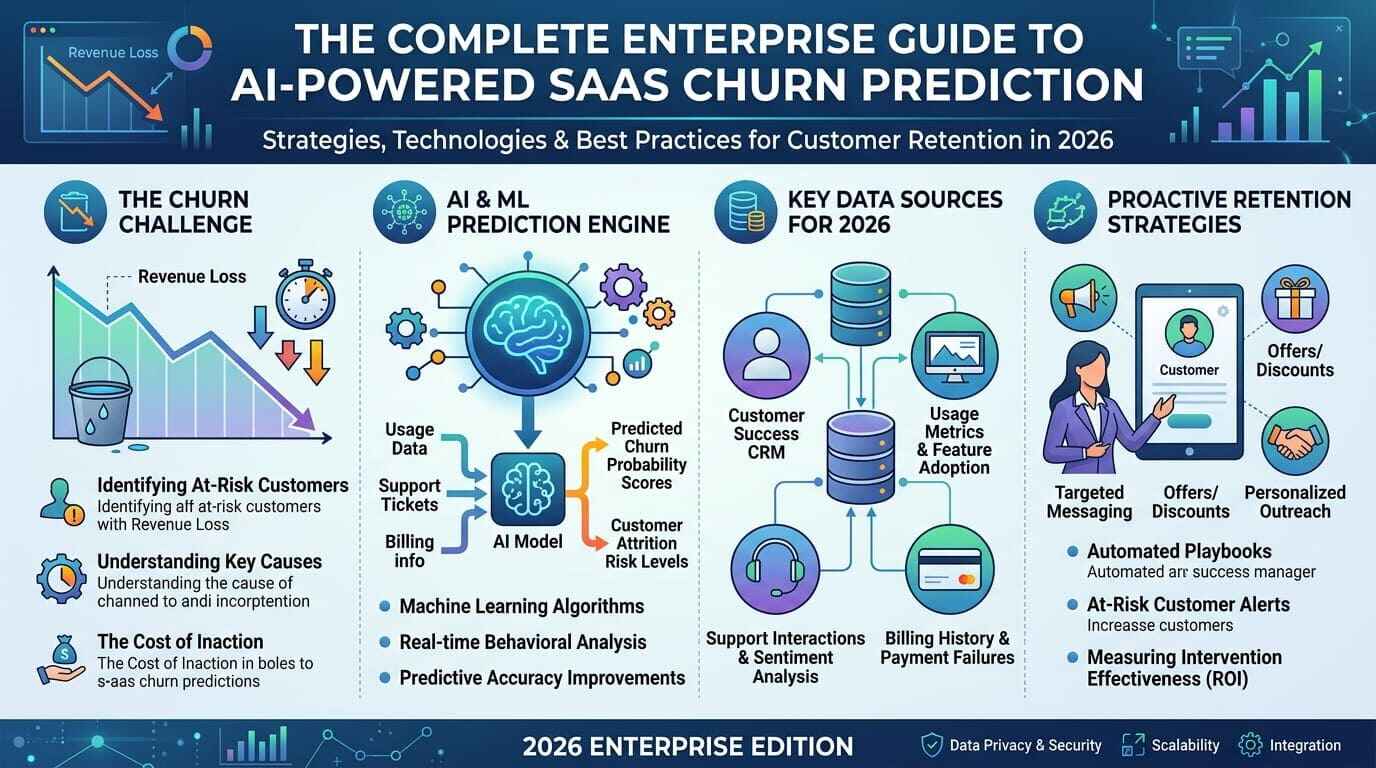
The quality of a churn prediction model is entirely determined by the quality and breadth of the signals it ingests. Effective churn prediction systems analyse behavioural, transactional, and demographic features such as usage frequency, subscription duration, payment patterns, and customer support interactions to predict churn probability. In practice, enterprise-grade AI-powered SaaS churn prediction systems use a much richer signal set, organised into four categories:
Product Engagement Signals
These are the highest-predictive-value signals available to most SaaS companies because they reflect actual value realisation rather than stated satisfaction:
- Feature adoption depth — Are customers using the core value-generating features, or only surface-level ones?
- Session frequency and recency — Is engagement trending up, flat, or declining over a 30/60/90-day rolling window?
- User seat utilisation — For seat-based pricing, what percentage of licensed users are actively logging in?
- Workflow completion rate — Are customers completing the jobs-to-be-done your product is designed for?
- Integration activity — Accounts with deep integrations to CRM, ERP, or data warehouse tools show dramatically lower churn propensity
Support and Relationship Signals
- Support ticket volume and sentiment — A sharp increase in ticket volume or a shift in sentiment toward frustration is a reliable leading churn indicator
- Response time to CSM outreach — Declining response rates to email or calendar invitations precede disengagement by an average of 60–90 days
- Executive sponsor changes — A new VP or C-level contact at the customer account is one of the strongest churn risk triggers in enterprise B2B, as new leaders often consolidate or replace incumbent vendors
- NPS and CSAT trend — Not the absolute score, but the trend direction over the last two to three survey cycles
Financial and Contractual Signals
- Payment delinquency patterns — Late payments are a reliable leading indicator of upcoming cancellation, particularly in SMB-leaning cohorts
- Contract tier versus actual usage — Accounts significantly over-paying for their actual usage are at high churn risk when renewal arrives
- Upsell/cross-sell acceptance rate — Accounts that consistently decline expansion offers show lower long-term retention propensity
- Renewal timeline — Accounts entering the 90-to-120-day pre-renewal window require elevated monitoring regardless of their health score
Market and External Signals
- Firmographic changes — Funding rounds, layoffs, M&A activity, and leadership changes are all publicly available signals that materially affect churn probability. Integrating churn predictions with financial planning tools enables real-time revenue forecasting — including modelling how a 15% rise in enterprise churn affects Q2 revenue. Lucid
- Competitive activity — Competitor product launches, pricing changes, or case study publications targeting your customer segment increase ambient churn risk across the cohort
Customer Retention Machine Learning: The Model Architecture Options
Gradient Boosting Machines (GBM): The Enterprise Standard
Gradient Boosting Machines — including XGBoost, CatBoost, and LightGBM — are among the highest-performing algorithms for churn prediction. Their strength comes from combining decision trees in a step-by-step process that improves accuracy at each stage. In real-world churn prediction studies, GBM models consistently rank at the top.
For most enterprise SaaS teams, a well-tuned GBM model operating on a 90-to-180 day prediction horizon represents the best combination of predictive accuracy, interpretability, and engineering complexity. GBM models are explainable at the account level — the model can tell you not just that an account is at risk but which specific signals are driving that risk score, enabling targeted CSM intervention rather than generic outreach.
Typical AUC (Area Under the Curve) performance for a well-trained GBM churn model on B2B SaaS data: 0.82 to 0.91. An AUC of 0.85 means the model correctly ranks a churning account above a non-churning account 85% of the time — enabling CSM teams to prioritise interventions with meaningful accuracy.
Customer Retention Machine Learning with Neural Networks
Neural networks have become more accessible by 2026. They excel at analysing large volumes of raw behaviour data and identifying relationships that simpler models cannot capture. Neural networks require more tuning, but the improvement in predictive power often justifies the complexity.
Neural network churn models are most valuable for SaaS companies with very high product event volumes — platforms generating millions of user interactions per day — where the raw behaviour signal density exceeds what GBM feature engineering can efficiently capture. The trade-off is interpretability: explaining to a CSM or account executive why a neural network scored an account at 87% churn probability is significantly more difficult than a GBM explanation.
Deep learning churn models are increasingly paired with SHAP (SHapley Additive exPlanations) values to generate human-readable account-level explanations — partially bridging the interpretability gap while retaining the accuracy advantage.
Survival Analysis: Predicting When, Not Just Whether
Survival analysis models are becoming increasingly important because retention strategies depend not only on identifying at-risk customers but also on interventions that reach them at the right time. Uzera
Traditional classification models answer: “Will this account churn?” Survival analysis answers: “When will this account churn, and by how much can we extend the survival time with an intervention?” This is the most strategically useful framing for enterprise CS teams managing renewal calendars — knowing that an account has a 70% probability of churning within 60 days versus within 9 months drives completely different intervention urgency and resource allocation.
Cox Proportional Hazards models and Accelerated Failure Time (AFT) models are the two most commonly deployed survival analysis frameworks in SaaS churn contexts in 2026.
Large Language Models for Qualitative Signal Integration
The newest development in AI-powered SaaS churn prediction is the integration of LLMs to process unstructured signals that traditional ML models cannot ingest: support ticket text, call transcripts, email thread sentiment, and QBR notes. LLMs extract structured risk signals from these sources — frustration language, competitor mentions, budget concerns, sponsor change indicators — and inject them as features into the primary GBM or neural network model.
This hybrid architecture — structured behavioural features processed by GBM, unstructured text features processed by LLM, combined in an ensemble — represents the current state of the art for enterprise churn prediction accuracy.
The Enterprise Implementation Roadmap
Phase 1: Data Foundation (Weeks 1–6)
The most common reason enterprise churn prediction projects fail is not model complexity — it is data quality. Before any model is trained, the data foundation must be established:
Required data sources for minimum viable churn prediction:
- Product event stream (login events, feature usage, API calls) — minimum 12 months of history
- CRM data (account details, CSM assignments, renewal dates, contract values) — Salesforce or HubSpot preferred
- Support ticketing system (volume, resolution time, sentiment) — Zendesk, Intercom, or equivalent
- Billing and subscription data (MRR, plan tier, payment history) — Stripe, Chargebee, or equivalent
Data ingestion should be centralised in a cloud data warehouse (Snowflake, BigQuery, or Databricks) before any modelling begins. Attempting to build churn models on fragmented, siloed data sources produces models that are difficult to maintain and impossible to operationalise.
Estimated data infrastructure investment (if not already in place): $5,000 / £3,942 / €4,650 to $25,000 / £19,710 / €23,250 per month for managed data warehouse and ETL tooling.
Phase 2: Baseline Model Development (Weeks 7–14)
Platforms like Pecan use automated machine learning to analyse historical customer data and build accurate churn prediction models with minimal effort, using conversational AI to help business analysts craft models and uncover insights without writing code.
For teams without an in-house data science function, no-code and low-code churn prediction platforms dramatically compress the time-to-value on Phase 2. For teams with ML engineering capability, building a custom GBM model in Python (scikit-learn, XGBoost, or LightGBM) typically requires 6 to 10 weeks for an experienced data scientist, including feature engineering, validation, and deployment.
Key Phase 2 deliverables:
- Trained baseline model with documented AUC and precision/recall metrics
- Account-level churn probability scores available via API or data warehouse export
- Feature importance report identifying the top 10 churn drivers for your specific customer base
- Initial cohort segmentation: High Risk (>70% churn probability), Medium Risk (40–70%), Low Risk (<40%)
Phase 3: CSM Workflow Integration (Weeks 15–20)
A churn prediction model that lives in a data warehouse and is never actioned by a CSM team generates exactly zero retention value. The critical integration layer is the CSM workflow — typically Salesforce, HubSpot, Gainsight, or ChurnZero — where account-level risk scores surface as health scores, alerts, and prioritised task queues.
Integration architecture:
- Churn probability scores refreshed daily or weekly via API call from the model serving layer to the CRM
- Risk tier changes trigger automated CSM task creation: “Account X moved from Medium to High Risk — schedule EBR within 7 days”
- Playbook assignment: High Risk accounts trigger a defined intervention playbook with specific outreach scripts, escalation paths, and executive sponsor engagement protocols
- CSM outcome logging: CSM marks interventions as completed; outcome (retained, churned, expanded) fed back as labelled training data for next model refresh
Phase 4: Continuous Model Improvement (Ongoing)
The system continues learning from new data, so predictions stay accurate over time. In practice, this requires a formal model refresh cadence — typically quarterly — that retrains the model on the last 12 to 18 months of labelled outcomes. Models trained on data that is more than 18 months old begin to drift as product changes, market conditions, and customer base composition evolve.
AI-Powered SaaS Churn Prediction: Tooling Landscape 2026
Enterprise-Grade Platforms
Gainsight + AI Layer: The dominant enterprise Customer Success platform, with AI-powered health scoring, churn risk alerts, and automated playbook triggering. Best for organisations with 500+ enterprise accounts and dedicated CS operations teams. Enterprise pricing from approximately $60,000 / £47,304 / €55,800 per year.
ChurnZero: Purpose-built for SaaS retention, with real-time churn scoring, journey automation, and deep CRM integration. Strong fit for mid-market SaaS ($10M–$100M ARR). Pricing from approximately $12,000 / £9,460 / €11,160 per year.
Totango: Composable Customer Success platform with modular AI-powered health scores. Particularly strong for SaaS businesses with complex, multi-product customer relationships. Enterprise pricing negotiated on contract size.
Predictive Analytics Specialists
Pecan AI: Automated ML platform that builds churn models without requiring data science expertise. Pecan connects to over 15 databases, data warehouses, and business applications — from Amazon Redshift and Snowflake to Salesforce and HubSpot — and its data pipeline automatically cleanses and prepares data for modelling. SaaS pricing on tiered plans; enterprise custom pricing available.
Mixpanel / Amplitude with ML Extensions: Product analytics platforms that have introduced predictive churn features using their native behavioural event data. Best for product-led growth SaaS businesses where product engagement is the primary retention driver.
Build-Your-Own (Open Source + Cloud ML)
For organisations with data engineering capability and large enough scale to justify the investment, a custom churn prediction stack using open-source components provides maximum flexibility:
- Feature store: Feast or Tecton for feature engineering and serving
- Model training: XGBoost or LightGBM in Python, managed via MLflow
- Model serving: FastAPI REST endpoint or Databricks Model Serving
- Orchestration: Apache Airflow or Prefect for scheduled training and scoring runs
- CRM integration: Salesforce CRM Analytics or custom Apex integration for score push
Build cost estimate for a custom enterprise stack: $150,000 / £118,260 / €139,500 to $400,000 / £315,360 / €372,000 in initial build cost, with $8,000 / £6,307 / €7,440 to $20,000 / £15,768 / €18,600 per month in ongoing operational cost.
ROI Framework: How to Model the Business Case
Most B2B teams see measurable churn reduction within 90 to 180 days. No-code tools deploy in 2 to 4 weeks; full ROI typically arrives in months 4 to 9. Enterprise custom builds take 6 to 12 months to ROI.
For finance leadership requiring a formal business case, the AI-powered SaaS churn prediction ROI model has three value streams:
Direct Revenue Retention: If your current annual gross churn rate is 15% on $20M / £15.77M / €18.6M ARR, and AI-powered churn prediction reduces that by 25% to 11.25%, the direct revenue retention value is $750,000 / £591,300 / €697,500 in year one — typically a 3x to 8x return on tooling investment.
CSM Productivity Multiplier: Churn risk prioritisation allows CSM teams to focus intervention effort on accounts where it has the highest impact, rather than spreading attention uniformly. Typical productivity improvement: 30–40% more at-risk accounts managed per CSM without headcount increase.
Expansion Revenue: Accounts identified as healthy in the churn model are prime expansion targets. Pairing churn prediction with expansion scoring — using the same signal architecture — enables CSM teams to run simultaneous retention and expansion plays with the same data infrastructure.
For a deeper look at how AI is reshaping SaaS revenue operations beyond retention, the enterprise SaaS workflow automation guide on this site covers the broader automation layer within which churn prediction sits.
Governance, Privacy, and Compliance Considerations
GDPR and CCPA Implications
Customer behavioural data used for AI-powered SaaS churn prediction is personal data under GDPR (in the EU) and CCPA (in California). Enterprise teams must ensure:
- Lawful basis for processing is documented — typically “legitimate interests” for B2B SaaS churn prediction, with a documented LIA (Legitimate Interests Assessment)
- Data minimisation — only signals genuinely predictive of churn are included in the model, not surplus personal data
- Retention limits — training data should not be retained beyond the period necessary for model validation and retraining, typically 24 months
- Processor agreements — if churn prediction tooling is SaaS-hosted, a Data Processing Agreement (DPA) must be in place with the vendor
Model Fairness and Explainability
For enterprise B2B SaaS, the primary governance concern is not demographic fairness (a consumer AI issue) but commercial fairness: ensuring the model does not systematically underserve certain customer segments — for example, accounts in specific geographies or industries — due to training data imbalances. Quarterly model audits should include cohort-level performance breakdowns to identify any systematic prediction bias.
For organisations building AI governance frameworks that span multiple AI systems, churn prediction models should be documented in the central AI system inventory with performance metrics, data lineage, and refresh cadences recorded.
FAQ: AI-Powered SaaS Churn Prediction
Q1: What AUC score should I target for an enterprise B2B SaaS churn prediction model to be operationally useful?
An AUC of 0.75 or above is generally sufficient to generate meaningful lift over a random or heuristics-based prioritisation approach, assuming the model is deployed with a well-designed CSM intervention workflow. AUC scores of 0.80 to 0.90 represent strong performance on typical B2B SaaS datasets. AUC above 0.90 is achievable but often requires either very large datasets (5,000+ labelled churn events) or very rich signal sources (deep product telemetry, NLP on support transcripts, integrated firmographic data). Do not reject a 0.78 AUC model in search of a theoretically better one — deployment and intervention execution quality determines retention outcomes more than marginal model accuracy improvements.
Q2: How much historical data is required to build a reliable SaaS churn prediction model?
As a minimum viable threshold, you need 12 months of complete product engagement and billing data, with at least 200 labelled churn events in the training set. For GBM models on SMB-oriented SaaS with high churn volumes, 6 months may be sufficient. For enterprise SaaS with annual contract renewal cycles and low churn rates (less than 5% annual), you may need 24 to 36 months of historical data to accumulate sufficient labelled churn examples for reliable model training. Teams with fewer than 100 historical churn events should use customer retention machine learning frameworks cautiously — model variance will be high, and cohort-level heuristics may outperform ML models at that data volume.
Q3: Should enterprise SaaS teams build their own churn prediction models or buy a platform?
The build-vs-buy decision hinges primarily on team capability, data complexity, and strategic differentiation. Buy a platform (Gainsight, ChurnZero, Pecan AI) if: you lack data science resources, you want time-to-value in weeks rather than months, or your churn signals are standard product engagement and CRM data. Build your own if: your product generates unique, high-volume behavioural signals that off-the-shelf platforms cannot model effectively; you require deep integration with proprietary data infrastructure; or churn prediction is a core competitive capability you want to own end-to-end. Hybrid approaches — using a vendor platform for baseline scoring and a custom ML layer for high-value enterprise accounts — are increasingly common in 2026.
Q4: How do you prevent CSM teams from ignoring AI churn risk scores?
Adoption failure is the single most common cause of AI-powered churn prediction programmes not delivering ROI. The proven solution is direct workflow integration rather than dashboard-first deployment. Risk scores must surface as actionable tasks inside the tools CSMs already live in (Salesforce, Gainsight, Slack), not as a separate system requiring a second login. Score changes should trigger automated task creation with specific prescribed actions, not just alerts. CSM managers should review prediction accuracy monthly and share win stories where early intervention saved at-risk accounts — building cultural trust in the model’s predictive validity over time.
json
{
  "@context": "https://schema.org",
  "@type": "FAQPage",
  "mainEntity": [
    {
      "@type": "Question",
      "name": "What AUC score should I target for an enterprise B2B SaaS churn prediction model to be operationally useful?",
      "acceptedAnswer": {
        "@type": "Answer",
        "text": "An AUC of 0.75 or above is generally sufficient to generate meaningful lift over a heuristics-based approach. AUC scores of 0.80 to 0.90 represent strong performance on typical B2B SaaS datasets. Deployment and intervention execution quality ultimately determines retention outcomes more than marginal model accuracy improvements."
      }
    },
    {
      "@type": "Question",
      "name": "How much historical data is required to build a reliable SaaS churn prediction model?",
      "acceptedAnswer": {
        "@type": "Answer",
        "text": "A minimum of 12 months of complete product engagement and billing data, with at least 200 labelled churn events in the training set. Enterprise SaaS with annual contracts and low churn rates may require 24 to 36 months of history. Teams with fewer than 100 historical churn events should use ML cautiously — cohort-level heuristics may outperform models at that data volume."
      }
    },
    {
      "@type": "Question",
      "name": "Should enterprise SaaS teams build or buy a churn prediction platform?",
      "acceptedAnswer": {
        "@type": "Answer",
        "text": "Buy if you lack data science resources, want deployment in weeks, or use standard product engagement signals. Build if your product generates unique high-volume behavioural data that off-the-shelf platforms cannot model, or if churn prediction is a core competitive capability. Hybrid approaches combining vendor baseline scoring with custom ML for enterprise accounts are increasingly common in 2026."
      }
    },
    {
      "@type": "Question",
      "name": "How do you prevent CSM teams from ignoring AI churn risk scores?",
      "acceptedAnswer": {
        "@type": "Answer",
        "text": "Integrate risk scores as automated tasks directly inside tools CSMs already use — Salesforce, Gainsight, Slack — rather than requiring a separate dashboard login. Score changes should trigger specific prescribed actions, not just alerts. Share monthly win stories where early prediction-driven intervention saved accounts to build cultural trust in the model over time."
      }
    }
  ]
}
Strategic Outlook & Implementation
In my 10 years of experience as a Manager scaling technical infrastructure, my consistent finding is that churn is a financial problem masquerading as a customer success problem. The data science and the ML architecture matter — but the conversation that unlocks investment in AI-powered SaaS churn prediction is almost always a CFO conversation, not an engineering one.
When I model the business case for a churn prediction programme, I always anchor it to ARR at risk, not to model accuracy. An AUC of 0.85 means nothing to a board. “We have $3.2M / £2.52M / €2.97M of ARR entering renewal risk in the next 90 days, and our current tooling gives us no visibility into which accounts are likely to cancel” — that is a conversation that moves capital.
My implementation advice for SaaS leaders reading this today: start with a 30-day data audit before committing to any tooling decision. Map every data source that touches your customer relationship — product events, CRM, support, billing — and assess its completeness and historical depth. That audit will tell you whether you are ready to buy and deploy a platform in weeks, or whether you need a Phase 1 data infrastructure sprint first. Do not skip the data audit. More churn prediction programmes fail at the data layer than at the model layer.
The ROI, when the programme is executed with discipline, is among the most reliable in all of enterprise software investment. Churn is one of the few business problems where the intervention cost (a CSM call, an executive sponsor touchpoint, a targeted offer) is orders of magnitude lower than the revenue at risk. AI-powered SaaS churn prediction simply makes sure that intervention happens before it is too late.
Conclusion
AI-powered SaaS churn prediction is the highest-ROI AI investment available to B2B SaaS organisations managing NRR as a primary business objective in 2026. The signal architecture, customer retention machine learning models, and intervention workflow infrastructure described in this guide are available to any organisation with 12 months of clean historical data and the operational discipline to integrate prediction into CSM workflows.
The organisations that deploy this infrastructure now — while their competitors are still managing churn reactively — will compound the retention advantage year-over-year as their models improve, their signal coverage expands, and their CSM teams develop the reflexes that come from acting on early-warning data rather than late-stage rescue requests.
For enterprise teams also evaluating the MCP protocol vs API gateway architecture for their AI data infrastructure, the same data platform that powers churn prediction can serve as the integration backbone for broader AI-driven customer intelligence programs.
Build the foundation. Train the model. Instrument the workflow. Protect the revenue.
Author Bio
Hi, I’m Ghulam Fareed. Over the last 10 years as a Digital Growth Specialist, I’ve focused on scaling technical B2B SaaS properties and navigating complex architectures. My work bridges the financial discipline of enterprise revenue protection with the technical depth that CS, product, and engineering leaders need to build AI programs that produce measurable business outcomes. If you are scaling a SaaS business and want frameworks that hold up under board scrutiny, this is the work I live in every day.